Weather watch: a depression passing
Spot the falling glass, read the gale warning, find the low by Buys Ballot, read the charts, judge fog risk and prepare for heavy weather.
- Phase 5: Passage planning and keeping the watch
- 8 steps on the bridge
- 5 oral questions
What you do on the bridge
- NAVTEX gale warning
- Read and log the glass
- Call the master
- Prepare for heavy weather
- Buys Ballot's law
- The forecast chart
- Fog risk in the warm sector
- Log the cold front
The oral questions, and what a good answer covers
The key points are in our own words. In the course, these questions come once you have done the job.
State Buys Ballot's law, and show how you would use it to find the centre of a low.Often asked
A good answer covers:
- In the Northern Hemisphere, stand with your back to the true wind and the low pressure is on your left
- In the Southern Hemisphere it is on your right
- Surface wind blows in across the isobars towards the low, so the centre lies a little forward of the beam; for a tropical storm, facing the wind, it is about 8 to 12 points to the right in the Northern Hemisphere
- Use the true wind, not the relative wind, and watch how the wind changes to see how the centre is moving
- For a ship stopped or moving slowly in the Northern Hemisphere, a steady veering wind puts you on the right of the track, a backing wind on the left
Show me on the bridgeRead the true wind on the anemometer display, then turn your back to it.
A depression passes to the north of you. Describe the weather as it goes by.Often asked
A good answer covers:
- Ahead of the warm front: the glass falls, cloud thickens and lowers, rain becomes continuous, the wind backs and freshens
- At the warm front: the wind veers, the rain eases to drizzle, the temperature and dew point rise
- In the warm sector: the glass is fairly steady, drizzle, poor visibility, mist or fog over a cooler sea
- At the cold front: heavy rain and squalls, a sharp veer, the temperature falls and the glass starts to rise
- Behind the cold front: the glass rises, visibility is good, showers, and often a strong north-westerly
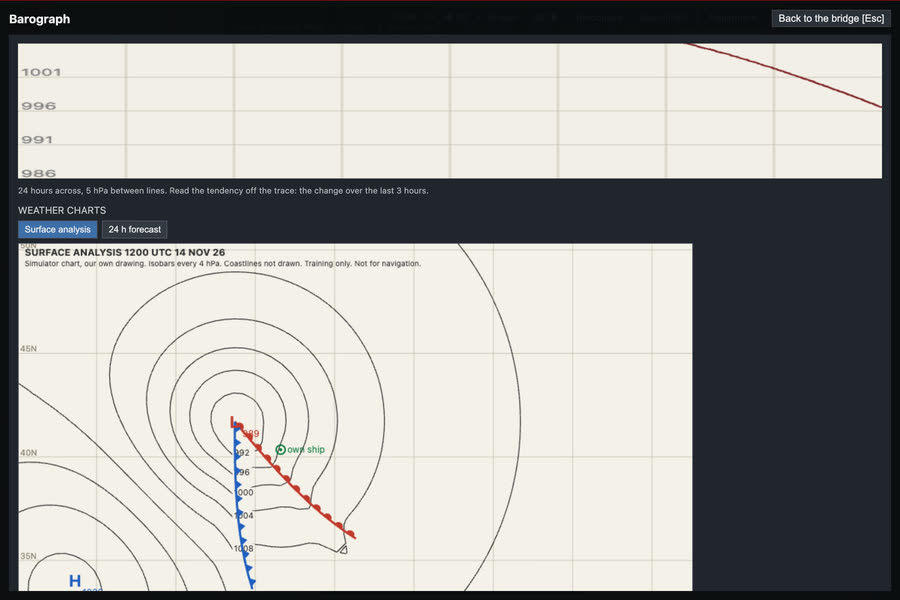
Show me on the bridgeLook at the barograph trace and the surface analysis chart pinned beside it.
How do you use the wet and dry bulb hygrometer to judge whether fog is likely?Often asked
A good answer covers:
- Read the dry bulb and the wet bulb; the difference is the depression of the wet bulb
- Enter the hygrometric table with the dry bulb and the depression to find the dew point and the humidity
- Compare the dew point with the sea temperature
- Sea temperature at or below the dew point: advection fog is likely as the air is cooled from below
- A small depression of the wet bulb means the air is close to saturation; keep watching it
Show me on the bridgeThe thermometer, the hygrometer and the sea temperature are on the after bulkhead.
What does the barometer tell you on watch, and when do you call the master about the weather?
A good answer covers:
- The reading itself matters less than the tendency over the last three hours, read off the barograph
- A fall of more than about 3.5 hectopascals in three hours is falling quickly, and more than 6 is very rapid: a depression or gale is likely close
- Log the reading and the tendency every watch, and more often when it is falling fast
- Call the master when the weather worsens or is forecast to, on a gale or storm warning, on a falling glass, or when in any doubt
- Prepare the ship for heavy weather early, while it is still easy to work on deck
Where do you get weather information at sea?
A good answer covers:
- NAVTEX: forecasts and gale warnings; meteorological warnings cannot be switched off
- SafetyNET by satellite for the high seas forecasts and warnings
- Weather charts by radio facsimile or by internet: surface analysis and forecast charts
- Coast radio and coastguard broadcasts on VHF and MF
- Your own observations: barometer, wind, sea, cloud, visibility and the hygrometer
How the lesson runs
The tutor's narration from the lesson, step by step. On the bridge, each control lights up as it is named.
Brief
We're south east of the Ambrose approach in the morning, heading offshore at six knots. It's raining, and a depression is coming up from the west.
Over the next few hours it passes to the north of us. We watch the glass, the wind and the air, read the warnings and the charts, and get the ship ready. Time compression helps here.
NAVTEX gale warning
A few minutes in, the NAVTEX prints a gale warning. Meteorological warnings are subject B, and the receiver will not let you switch them off.
Read it within ten minutes of it printing. Note where the low is, which way it is going, and what the wind will do.
Read and log the glass
Now the barometer. The reading matters less than the tendency: how much it has changed over the last three hours. Read that off the barograph trace.
Within twenty minutes, write the weather line in the deck log, and put the tendency in the remarks, for example falling six hectopascals in three hours. It's falling fast.
Call the master
A gale warning and a glass falling this fast are both reasons to call the master. Do it within ten minutes of reading the warning, and say why.
Prepare for heavy weather
Get the ship ready while it is still easy to work on deck. Work the heavy weather checklist within thirty minutes of the warning.
Check the doors and the stabilisers before you tick them. The simulator checks those two, and a false tick fails the item.
Buys Ballot's law
Where is the low now? Take the true wind from the anemometer display. With your back to the wind, in the northern hemisphere, the low is on your left, a little ahead of abeam.
So add about a hundred and ten degrees to the direction the wind comes from. Hand in that bearing at the weather charts. Your first answer counts, and it must be within forty degrees.
The forecast chart
The surface analysis shows the low, its fronts and the isobars now. Open the twenty four hour forecast and find our planned position.
Wind runs nearly along the isobars, low pressure on its left, turned in a little towards the low. Read the direction it will blow from there, and hand it in. Within forty five degrees passes.
Fog risk in the warm sector
When the warm front goes through, the wind veers, the rain turns to drizzle and the air gets warmer and damper. That's the warm sector.
Read the dry and wet bulb, find the dew point in the table, and compare it with the sea temperature. If the sea is at or below the dew point, fog is likely. Hand in your judgement there.
Log the cold front
Hours later the cold front comes through: heavy rain, a sharp veer to the north west, the temperature drops and the glass starts to rise.
Once it has passed, write a full weather line in the deck log, and note the front and the wind shift in the remarks.
Do it, then explain it.
Read the answers here for free. With a pass you work this lesson on the bridge, then practise its questions and mark your answers.