Taking over the night watch
Read and sign the orders, work the taking-over checklist honestly, then call the master and work the fog checklist when visibility drops.
- Phase 5: Passage planning and keeping the watch
- 4 steps on the bridge
- 4 oral questions
What you do on the bridge
- Read and sign the orders
- Taking-over checklist
- Call the master
- Restricted visibility checklist
The oral questions, and what a good answer covers
The key points are in our own words. In the course, these questions come once you have done the job.
What do you satisfy yourself of before you take over a navigational watch?Often asked
A good answer covers:
- The master's standing orders and any night orders or special instructions, read and signed
- Position, course, speed and draught, and the next part of the passage plan
- Tides, currents, weather and visibility, and how they will affect the ship
- Traffic about, what is being tracked, and any vessel of concern
- The state of the navigation equipment: steering mode, engines, compass errors, alarms, and any defects
- Navigation lights right for what the ship is doing
- Your eyes adjusted to the light before you accept the watch
Show me on the bridgeThe chart table: the orders and the taking-over checklist are under Orders and checklists.
When should a watch not be handed over?Often asked
A good answer covers:
- Not while a manoeuvre or avoiding action is under way: finish it first
- Not until the relieving officer is fully able to take over, rested, fit and with their eyes adjusted
- If the relieving officer is not fit for duty, do not hand over and tell the master
- Until the handover is complete, the officer going off watch stays responsible
Visibility closes in during your watch. What do you do?Often asked
A good answer covers:
- Call the master, as the night orders say and as STCW expects
- Sound the fog signal for a power-driven vessel making way
- Both radars running and plotting, with targets acquired
- Navigation lights on, and an extra lookout posted, listening as well as watching
- A safe speed, with the engines ready for immediate manoeuvre, and hand steering considered
- Time and position entered in the log
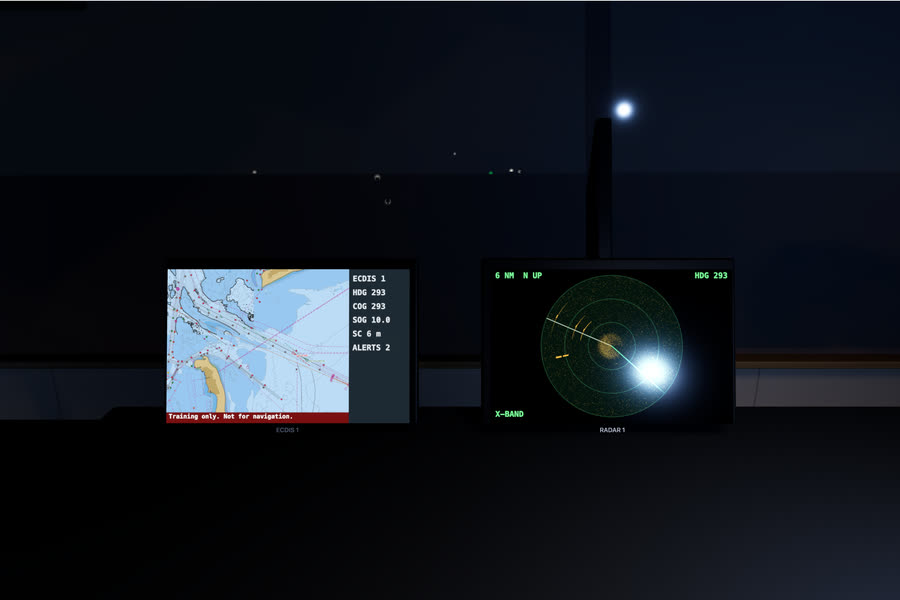
Show me on the bridgeFog comes in after about ten minutes. Look out of the windows, then at the radars.
What's the difference between the standing orders and the night orders?
A good answer covers:
- Standing orders are the master's lasting instructions for every watchkeeper on board
- Night orders are the master's instructions for one particular night, written for that passage
- Night orders add to the standing orders; they do not cancel them
- Each officer reads and signs both before taking the watch
- They often set figures, such as the visibility at which to call the master
How the lesson runs
The tutor's narration from the lesson, step by step. On the bridge, each control lights up as it is named.
Brief
It's midnight, open water south of the Ambrose approach, on the autopilot at eight knots. You're taking over from the officer going below.
The orders and checklists are at the chart table, under Orders and checklists. A tick there is your word that something is so, so only tick what you have checked.
Read and sign the orders
Start with the master's standing orders and tonight's night orders. Read them properly, then sign each one, inside five minutes.
Note the figure in the night orders: the master wants a call if visibility falls below three miles. You'll need that later.
Taking-over checklist
Now work the taking-over checklist, inside ten minutes. Look at each thing before you tick it: position, traffic, weather, lights, equipment, and your eyes.
Have a good look at the navigation lights. If one is not right, put it right first, and only then tick it. A false tick fails the item.
Call the master
About ten minutes in, the fog comes down. Visibility is now well under the three miles in the night orders. Call the master within three minutes, and say why.
Restricted visibility checklist
While the master comes up, work the restricted visibility checklist within ten minutes of the fog. Do each thing first, then tick it.
That means the fog signal for a vessel making way, both radars transmitting, the lights on, an extra lookout, a safe speed with the engines ready, and the time and position in the log.
Do it, then explain it.
Read the answers here for free. With a pass you work this lesson on the bridge, then practise its questions and mark your answers.