See how the ship answers.
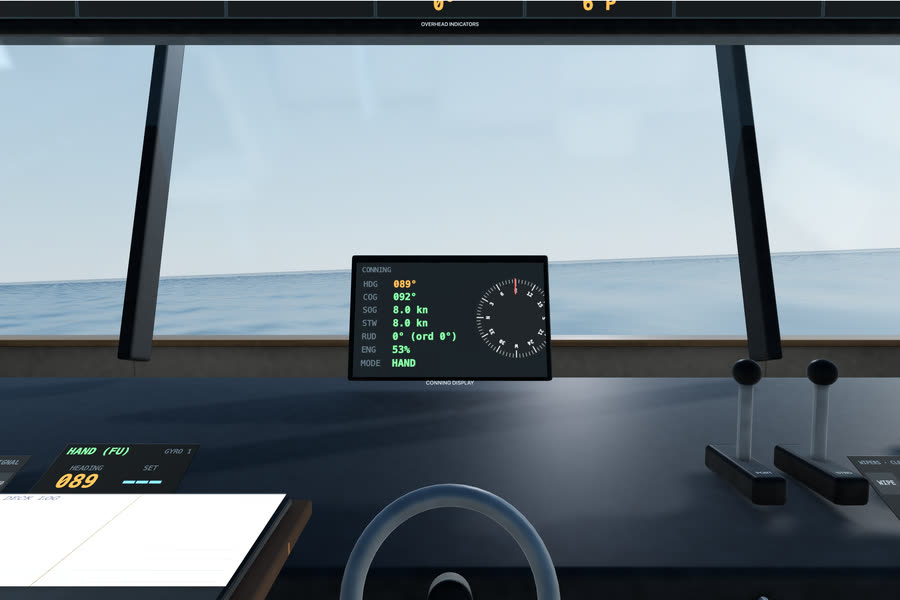
Test the steering gear before departure, change over to emergency steering, give helm orders, anchor and keep the anchor watch, allow for squat, meet a big ship overtaking in a channel and berth from the wing.
Why it matters in the oral
Ship handling questions test whether you know what the ship will do before she does it: why she sits lower in shallow water, why a ship passing close can draw you in, how much cable to give her at anchor.
Here you handle the ship yourself and see the effect, then answer the questions that go with each lesson.
The lessons
8 lessons on the bridge.
Each has its own page: what you do, how the lesson runs and its oral questions.
Phase 1: The bridge, one piece of equipment at a time
Steering gear test before departure
Test each pump, each control system, local control and the alarms, then leave it ready for sea.
Phase 6: Emergencies and ship handling
Emergency steering drill
Bridge steering fails at sea: answer the alarm, start the second pump, steer from the steering gear room, then hand back.
Phase 6: Emergencies and ship handling
Anchoring and the anchor watch
Slow approach, stop, gentle sternway, let go and pay out; then the anchor position, the watch circle, and what to do when she drags.
Phase 6: Emergencies and ship handling
Helm orders to a helmsman
Put a helmsman on a course, give rudder orders, hear them repeated and reported, steady her and bring her back.
Phase 6: Emergencies and ship handling
Squat and under keel clearance
Run over shallow water at speed, see the clearance under the keel shrink, and slow her down to get it back.
Phase 6: Emergencies and ship handling
Interaction: a big ship overtaking in a channel
A container ship overtakes close in the Ambrose Channel. Open the gap before she draws level, let her pass and come back to the channel course.
Phase 6: Emergencies and ship handling
Berthing from the wing
Take control at the port wing, come in slowly, land softly on the fenders and lie alongside the pontoon.
Phase 6: Emergencies and ship handling
Embarking a pilot
Call the pilot station, make a lee at the speed asked for, rig the ladder on the right side at the right height, and hold her until the pilot is aboard.
Oral questions
Ship handling questions, and what a good answer covers.
Six of the most-asked. In the course, each one follows the lesson where you have just done it.
When must the steering gear be tested, and what goes in the test?Often asked
A good answer covers:
- Each pump alone, and both together where they can run together
- Full movement both ways, hard over to hard over, and the time taken
- Each remote control system, and the emergency or local control
- The rudder angle indicator agrees with the actual rudder angle
- The power unit failure and control system alarms
- Entered in the deck log
Practised in the lesson Steering gear test before departure.
Show me on the bridgeStopped before departure, with the steering test ahead of you.
How often are emergency steering drills held, and what do they practise?Often asked
A good answer covers:
- Direct control from the steering gear compartment
- The communication procedure between the bridge and the steering gear room
- Operating the alternative power supply where fitted
- The date and details entered in the log
Practised in the lesson Steering gear test before departure.
You are on watch and the steering fails. Talk me through your actions.Often asked
A good answer covers:
- Acknowledge the alarm and check what has failed: rudder against the order, pumps, control system
- Call the master, and the engineer to the steering gear room
- Start the second pump and try the other control system and the NFU tiller
- If the bridge cannot steer, take local control in the steering gear room with the bridge giving orders
- Use the engines and thrusters to hold the heading or take the way off if there is danger close
- Show not under command lights or shapes if she cannot manoeuvre, and warn traffic and the VTS
- Log it all, and report it as the master directs
Practised in the lesson Emergency steering drill.
Show me on the bridgeAt sea on the autopilot. The steering will fail soon after you start.
How often are emergency steering drills held, and what must they include?Often asked
A good answer covers:
- Direct control from the steering gear compartment
- The communication procedure between the bridge and the steering gear room
- Operating the alternative power supply where one is fitted
- The date and details recorded in the log
Practised in the lesson Emergency steering drill.
How much cable do you put out, and what makes you put out more?Often asked
A good answer covers:
- More in strong wind, a strong stream, poor holding ground or a long stay
- Enough swinging room for the cable plus the length of the yacht
- The cable should lead well out and the anchor must be dug in before you leave it
Practised in the lesson Anchoring and the anchor watch.
Show me on the bridgeTen metres of water at the berth. Work out the cable before you let go.
Describe how you bring the yacht to the anchor berth and let go.Often asked
A good answer covers:
- Approach slowly, ideally heading into the wind or stream, whichever is stronger
- Stop at the berth, then a touch of sternway so the cable lays out clear
- Let go, then pay out under the brake, not all at once
- Brought up when the cable rises and then slackens and she lies quietly to it
- Fix the anchor position and set the anchor watch
Practised in the lesson Anchoring and the anchor watch.
All 29 Ship handling questions
Preparing for the OOW 3000 oral? See the whole syllabus, topic by topic. Other topics: Radar and ARPA, ECDIS and electronic aids, Position fixing, Passage planning, COLREGs, Watchkeeping, Pilotage, GMDSS and distress, Emergencies, Weather.