Know where you are without the GNSS.
Fix by visual bearings and radar ranges, allow for leeway in a running fix, work compass error by azimuth, amplitude and a transit, use sextant angles and the sun, and watch a light rise on a clear night.
Why it matters in the oral
Examiners like to switch the GNSS off. Then they want to hear how you would fix the ship, how often, and how you would know the compass is telling the truth.
Here the GNSS fails while the ship is moving. You take the bearings, ranges and sights yourself and put the fix on the chart, then answer the questions that go with each method.
The lessons
9 lessons on the bridge.
Each has its own page: what you do, how the lesson runs and its oral questions.
Phase 1: The bridge, one piece of equipment at a time
The compasses: gyros, repeaters and the magnetic compass
Find the heading changeover and the magnetic compass, line up a wing repeater, take a bearing, and change over when a gyro fails.
Phase 3: Fixing the position
GNSS lost: fix by visual bearings
Both GNSS fail in the approach: acknowledge, take three quick bearings from the wing and fix the ship in the ECDIS.
Phase 3: Fixing the position
Compass error by azimuth and amplitude
Find the gyro error from the sun, check the standard compass against it, log the comparison, and take an amplitude at sunset.
Phase 3: Fixing the position
Compass error by a transit: the Sandy Hook range at dusk
Identify a pair of range lights, take a gyro bearing as they come in line, find the gyro error from the charted bearing, then check the standard compass.
Phase 3: Fixing the position
Vertical and horizontal sextant angles
Distance off a lighthouse by vertical sextant angle, and a station pointer fix from two horizontal angles.
Phase 3: Fixing the position
A day's work by the sun: sun-run-sun
Index error, a morning sun sight worked and plotted, the noon latitude, and the morning line run up to a noon fix.
Phase 3: Fixing the position
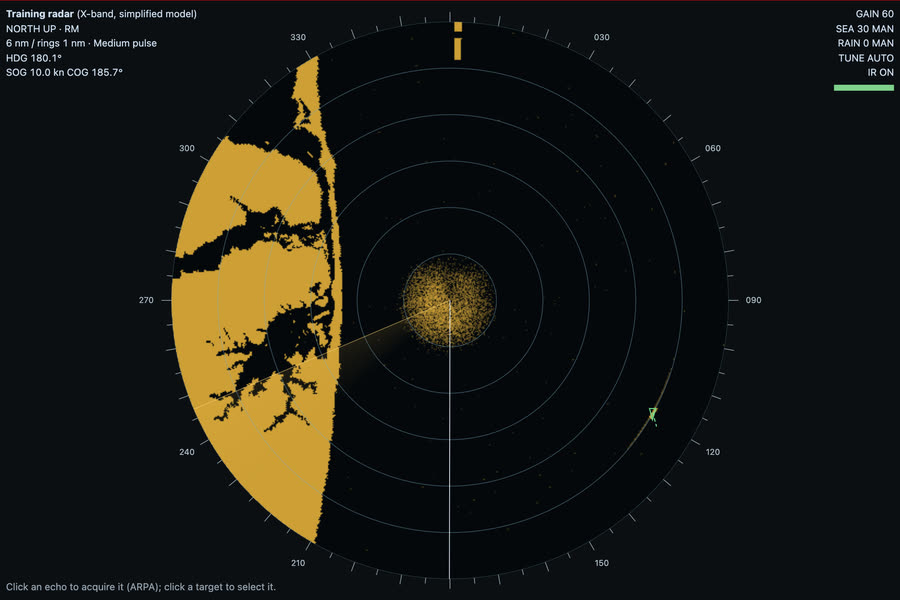
Fixing by radar ranges, and a running fix
Both GNSS fail: fix by radar ranges of charted marks on the ECDIS, then a running fix, and log it.
Phase 3: Fixing the position
Leeway in a running fix
A near gale on the beam: find the leeway, take two bearings ten minutes apart, and run the first on along the water track.
Phase 3: Fixing the position
A light rising and dipping: Sandy Hook on a clear night
Work out a rising range, watch the light rise from the monkey island, see it dip from the bridge wing, and fix her by the rising range and a bearing.
Oral questions
Position fixing questions, and what a good answer covers.
Six of the most-asked. In the course, each one follows the lesson where you have just done it.
Compare the gyro compass and the magnetic compass. Why carry both?Often asked
A good answer covers:
- The gyro seeks true north, has a small and steady error, and feeds the autopilot, radar, ECDIS, AIS and repeaters
- But it needs power, takes hours to settle after starting, and has speed and latitude errors that need correcting
- The magnetic compass needs no power and cannot fail electrically, so it is the independent back-up
- But it points to magnetic north, so it carries variation and deviation, and it is disturbed by steel, cargo and electrical equipment
- SOLAS requires a magnetic compass on every ship covered, and a gyro on ships of 500 GT and over
Practised in the lesson The compasses: gyros, repeaters and the magnetic compass.
Show me on the bridgeThe heading changeover panel and the compass projector at the helm.
Explain variation and deviation, and how you go from a compass course to a true course.Often asked
A good answer covers:
- Variation: the angle between true and magnetic north, from the chart, changing with place and slowly with time
- Deviation: the angle between magnetic north and where the compass points, caused by the ship's own magnetism, and changing with heading
- Compass error is variation and deviation combined
- Compass to true: apply deviation to get magnetic, then variation to get true; easterly errors are added, westerly subtracted
- Deviation comes from the deviation card, and is checked by comparison and by azimuth
Practised in the lesson The compasses: gyros, repeaters and the magnetic compass.
The gyro feeding the autopilot fails. What do you do?Often asked
A good answer covers:
- Take hand steering if the autopilot has lost its heading, and steer by the magnetic compass if need be
- Change the heading source to the other gyro, or the magnetic heading, and check every receiver has it: autopilot, radar, ECDIS, AIS
- Remember radar stabilisation and ARPA are upset by a heading failure until the new source is in
- Call the master, log it, and tell the engineers or electro-technical officer
Practised in the lesson The compasses: gyros, repeaters and the magnetic compass.
You are in the approach and the ECDIS loses its GNSS position. What do you do?Often asked
A good answer covers:
- Acknowledge the alarm and note the time; the ECDIS is now running on dead reckoning
- Check the other receiver and the antenna feed before deciding it is a real loss
- Fix the ship at once by independent means: visual bearings, radar ranges, transits
- Enter the fix in the ECDIS as a manual fix so the DR restarts from a true position
- Shorten the fix interval, keep a good lookout, and call the master
- Warn other users of the position, such as the AIS, DSC and the radar, that their input is now poor
Practised in the lesson GNSS lost: fix by visual bearings.
Show me on the bridgeBoth receivers stop a minute in. Watch the alarm and the position source change to DR.
How do you choose the marks for a three-bearing fix, and in what order do you take them?Often asked
A good answer covers:
- Charted, positively identified marks, ideally fixed lights or headlands rather than buoys
- Spread so the position lines cross well: about 60 degrees apart for three, near 90 for two
- Near marks rather than far ones, since an angular error moves the line less
- Bearings ahead or astern first, as they change slowly; the one near the beam last, as it changes fastest
- Take them quickly, note the time, and plot at once
Practised in the lesson GNSS lost: fix by visual bearings.
Show me on the bridgeFrom the starboard wing, say which marks you would use and why.
When do you check the compass error, and how?Often asked
A good answer covers:
- By azimuth of a celestial body, by amplitude at sunrise or sunset, or by a charted transit
- Gyro error first, then the standard compass by comparison with the corrected gyro
- Every result in the compass error book, and any change from the usual error looked into
Practised in the lesson Compass error by azimuth and amplitude.
Show me on the bridgeThe sun is low to the west. Stand at the repeater and look at it through the azimuth ring.
All 34 Position fixing questions
Preparing for the OOW 3000 oral? See the whole syllabus, topic by topic. Other topics: Radar and ARPA, ECDIS and electronic aids, Passage planning, COLREGs, Watchkeeping, Pilotage, GMDSS and distress, Emergencies, Ship handling, Weather.