Take the watch, keep it, hand it over.
The bridge equipment and its alerts, the BNWAS test, reporting to the VTS, taking over the night watch, keeping your night vision with both radars running, and speaking up when the pilot gets it wrong.
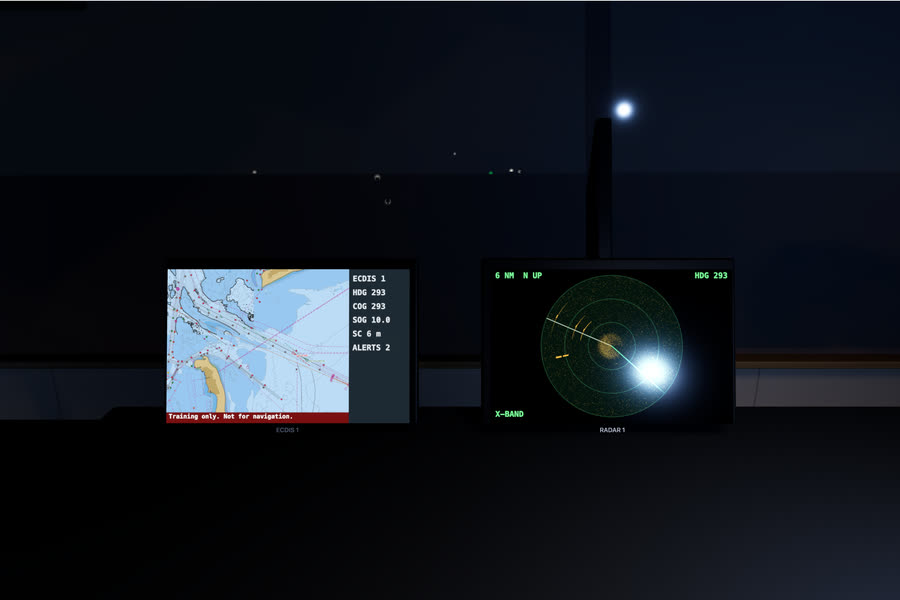
Why it matters in the oral
Much of the oral is about the watch itself: what you check before you take it over, what you do through the night, and when you call the master. Examiners expect a clear routine, said in order.
Here you stand the watch on a moving ship, with the night orders, the traffic and the VTS to deal with, then answer the questions an examiner asks about it.
The lessons
8 lessons on the bridge.
Each has its own page: what you do, how the lesson runs and its oral questions.
Phase 0: Using the simulator
Using the simulator: views, stations, the ECDIS tabs and the clock
Find your way round the simulator before the course starts: the bridge view and its stations, the radar, the ECDIS tabs, and time compression.
Phase 1: The bridge, one piece of equipment at a time
The bridge controls: steering, engines, whistle, VHF, alerts, deck log and VDR
Use the controls every later lesson relies on: hand steering and autopilot, the telegraph, the whistle, the VHF, the central alert panel, the deck log and the VDR.
Phase 1: The bridge, one piece of equipment at a time
BNWAS test
Test every stage, every reset device and the emergency call, find the faulty reset, and leave the BNWAS as the master set it.
Phase 5: Passage planning and keeping the watch
Reporting to the VTS inbound
Find the reporting points and the channel in the pilot book and radio list, and report at each point from inside its circle.
Phase 5: Passage planning and keeping the watch
Taking over the night watch
Read and sign the orders, work the taking-over checklist honestly, then call the master and work the fog checklist when visibility drops.
Phase 5: Passage planning and keeping the watch
Bridge team challenges: speaking up to the pilot
The pilot orders a course that takes her out of the channel. Check it, speak up, and escalate until it is put right.
Phase 5: Passage planning and keeping the watch
Night watch: night vision, both radars, ECDIS take-over
Set the bridge up for the night, keep both radars running, take over on the back-up ECDIS when the main one fails, and keep clear.
Phase 6: Emergencies and ship handling
Preparing for the pilot and the master-pilot exchange
Make the bridge ready for the pilot, fill in the pilot card, then hand it over, check his plan against ours and agree the con.
Oral questions
Watchkeeping questions, and what a good answer covers.
Six of the most-asked. In the course, each one follows the lesson where you have just done it.
How do you change over from autopilot to hand steering, and when would you?Often asked
A good answer covers:
- In traffic, in restricted visibility, in narrow waters, or whenever the master orders, and with time to spare
- Have the helmsman at the wheel first, then select hand steering and give a course to steer
- Check the helmsman is steering well and the rudder indicator follows the wheel
- Changing back: line up on the course, set the autopilot heading, then select autopilot and watch it hold
- Test the hand steering after a long spell on the autopilot, and before entering waters that need special caution (SOLAS V/24)
Practised in the lesson The bridge controls: steering, engines, whistle, VHF, alerts, deck log and VDR.
Show me on the bridgeThe helm station: the wheel, the NFU tiller and the steering mode selector.
What are the priorities of bridge alerts, and what is the difference between silencing and acknowledging?Often asked
A good answer covers:
- Emergency alarm, alarm, warning and caution, in falling order of urgency
- An alarm needs immediate attention and action; a warning needs attention, and becomes an alarm if left; a caution is for awareness only
- Silencing stops the sound for a short time but leaves the alert active and unacknowledged
- Acknowledging means you have seen it and taken responsibility; it should be done where the problem can be dealt with
Practised in the lesson The bridge controls: steering, engines, whistle, VHF, alerts, deck log and VDR.
What is a BNWAS for, and how does it work when nobody resets it?Often asked
A good answer covers:
- It checks the officer of the watch is awake and on the bridge, and calls help if not
- After the dormant period, set between 3 and 12 minutes, a visual indication on the bridge
- Then an audible alarm on the bridge, 15 seconds after the visual one
- Then, 15 seconds later, the alarm at the master and the back-up officer, and 90 seconds after that (up to 3 minutes on larger ships) at other crew locations
- The emergency call sends it straight to the master and back-up officer
Practised in the lesson BNWAS test.
Show me on the bridgeOpen the BNWAS panel: mode, dormant timer, stage lamps and the reset.
What are the operating modes, and who may change them?Often asked
A good answer covers:
- Automatic: running whenever the autopilot or track control is engaged
- Manual on: always running
- Manual off: not running
- Mode and dormant period are protected by the master's key or a password, so the watch cannot change them
Practised in the lesson BNWAS test.
What is a VTS, and what can it do for you?Often asked
A good answer covers:
- A shore service that watches and manages traffic in a port or busy area, set up by the coastal state
- An information service: traffic, hazards, weather and the state of the fairway, given at set times or when asked
- Navigational assistance, where it is offered, to help a ship that asks for it or needs it
- Traffic organisation: planning movements to prevent dangerous situations
- The master stays responsible for the ship, and the rules of the road still apply
Practised in the lesson Reporting to the VTS inbound.
Where do you find a VTS's reporting points and channels, and when do you look?Often asked
A good answer covers:
- At the passage planning stage, so the points are on the chart and in the plan before you arrive
- The pilot book, or sailing directions, for the points and what each report must contain
- The radio list for the VTS name, its channels and hours
- Chart notes and the port guide, and the latest notices to mariners for any changes
- Check the channel against the latest correction: channels do change
Practised in the lesson Reporting to the VTS inbound.
Show me on the bridgeChart table, Pilot and radio list. Find the reporting points and the VTS channel.
Preparing for the OOW 3000 oral? See the whole syllabus, topic by topic. Other topics: Radar and ARPA, ECDIS and electronic aids, Position fixing, Passage planning, COLREGs, Pilotage, GMDSS and distress, Emergencies, Ship handling, Weather.