When it goes wrong, act in the right order.
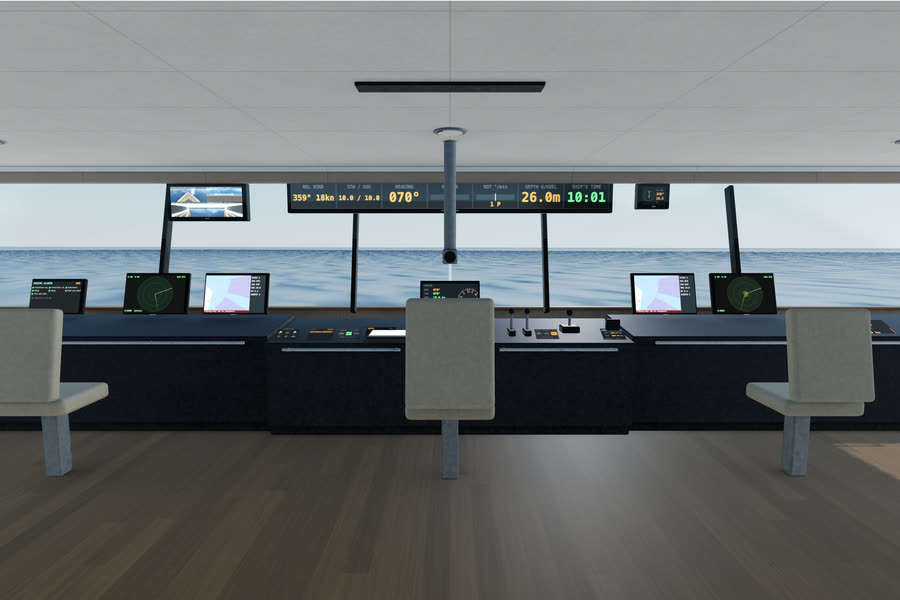
A fire alarm in the guest cabins, a fire in the tender garage, a man overboard, a grounding, an oil spill on deck and an expanding square search for a liferaft, each run from the bridge.
Why it matters in the oral
Examiners ask about emergencies to hear your first actions, in order, and who you tell. A long list in the wrong order does not convince.
Here the emergency happens in front of you. You raise the alarm, manoeuvre, signal and report as the procedure asks, then answer the questions that go with it.
The lessons
6 lessons on the bridge.
Each has its own page: what you do, how the lesson runs and its oral questions.
Phase 1: The bridge, one piece of equipment at a time
Fire alarm in the guest cabins
Accept the alarm and send someone to look before acting: no general alarm for a false alarm, then reset and tell the Master.
Phase 6: Emergencies and ship handling
Fire in the tender garage
Accept the alarm, send someone, call the Master, then raise the alarm, shut the zone down, start the pump and put the wind right.
Phase 6: Emergencies and ship handling
Man overboard
Mark, throw, turn and alarm; a Williamson turn back down the track, then a slow approach upwind and engines stopped.
Phase 6: Emergencies and ship handling
Aground: stop, assess the damage, signal and report
She touches bottom at night on a falling tide: stop the engines, alarm and doors, the master, aground lights, tank and hull soundings, the tide, a PAN PAN, the VDR and the log.
Phase 6: Emergencies and ship handling
Oil spill on deck: the SOPEP, containing it and reporting it
A fuel vent overflows on deck: stop the transfer, raise the alarm, plug the scuppers and lay absorbents, report to the coastal state and the company, and record it.
Phase 6: Emergencies and ship handling
Search and rescue: an expanding square for a liferaft
Plan an expanding square from the datum as an ECDIS route, sail it, find the liferaft by eye, close it slowly and report it.
Oral questions
Emergencies questions, and what a good answer covers.
Six of the most-asked. In the course, each one follows the lesson where you have just done it.
One detector goes into alarm in the guest cabins. How do you decide whether it is a real fire?Often asked
A good answer covers:
- Treat it as a real fire until someone has been and looked
- Accept it at the panel, note the zone and detector, and send someone with a radio at once
- Look for more: a second detector, smoke on CCTV, other reports
- If it is confirmed, sound the general alarm straight away; if it is clear, no general alarm
- Tell the Master either way
Practised in the lesson Fire alarm in the guest cabins.
Show me on the bridgeOpen the fire detection panel and the reports to the bridge.
The fire panel shows a fire alarm in the tender garage. What do you do on the bridge?Often asked
A good answer covers:
- Accept the alarm at the panel, note the zone and detector, and send someone to look
- Call the Master
- Once it is confirmed, sound the general alarm and tell everyone over the PA what and where
- Stop the ventilation to the zone and close the fire doors, and start the fire pump
- Put the ship so the wind keeps the smoke and fire clear of the accommodation, and slow down
- Keep a record of times and actions, save the VDR, and consider an urgency or distress message
Practised in the lesson Fire in the tender garage.
Show me on the bridgeOpen the fire detection panel: the zones, accept, reset, general alarm and the PA.
Why alter course and speed for a fire, and which way would you put the wind?Often asked
A good answer covers:
- The wind across the deck carries smoke and flame, and feeds the fire with air
- A fire aft: put the wind ahead, so the smoke blows aft and clear of the accommodation
- A fire forward: put the wind astern, or on the quarter, for the same reason
- Slow down to cut the wind over the deck, but keep steerage way
- Keep clear of traffic and shoal water while you do it
Practised in the lesson Fire in the tender garage.
Show me on the bridgeLook at the wind against your heading. Where would smoke from aft blow?
Someone shouts man overboard, starboard side. What do you do in the first minute?Often asked
A good answer covers:
- Press the MOB button on the ECDIS or GNSS to mark the position
- Release a lifebuoy with light and smoke from the side the person went over
- Put the helm over towards that side to swing the stern clear of the person
- Sound the general alarm and the man overboard signal on the yacht's muster list, and hoist or show flag O
- Post a lookout to keep the person in sight and point
- Call the Master, and make a PA so the crew muster
Practised in the lesson Man overboard.
Show me on the bridgeA minute in, the deckhand shouts. Be ready on the wheel.
Compare the Williamson turn and the Anderson turn. When would you use each?Often asked
A good answer covers:
- Williamson: hard over; at 60 degrees off the original course, hard over the other way; about 20 degrees short of the reciprocal, midships and steady on it
- Williamson brings her back down her own track: good at night, in poor visibility, or when the fall was not seen at once
- Anderson is fastest when the person is in sight and the ship turns tightly, such as a twin screw yacht
Practised in the lesson Man overboard.
How do you make the final approach to pick the person up?Often asked
A good answer covers:
- Slowly, under full control, with the person always in sight
- Stop upwind of them so the yacht drifts down and gives them a lee
- Bring them alongside the recovery side, well forward of the propellers
- Stop the engines, or at least the propeller on that side, before they are close
- Recovery crew ready with a line, a sling or a recovery net, and the rescue boat as an option
Practised in the lesson Man overboard.
Show me on the bridgeAt dusk, with a port side fall. Watch the lifebuoy light as you come back.
Preparing for the OOW 3000 oral? See the whole syllabus, topic by topic. Other topics: Radar and ARPA, ECDIS and electronic aids, Position fixing, Passage planning, COLREGs, Watchkeeping, Pilotage, GMDSS and distress, Ship handling, Weather.