Leeway in a running fix
A near gale on the beam: find the leeway, take two bearings ten minutes apart, and run the first on along the water track.
- Phase 3: Fixing the position
- 3 steps on the bridge
- 3 oral questions
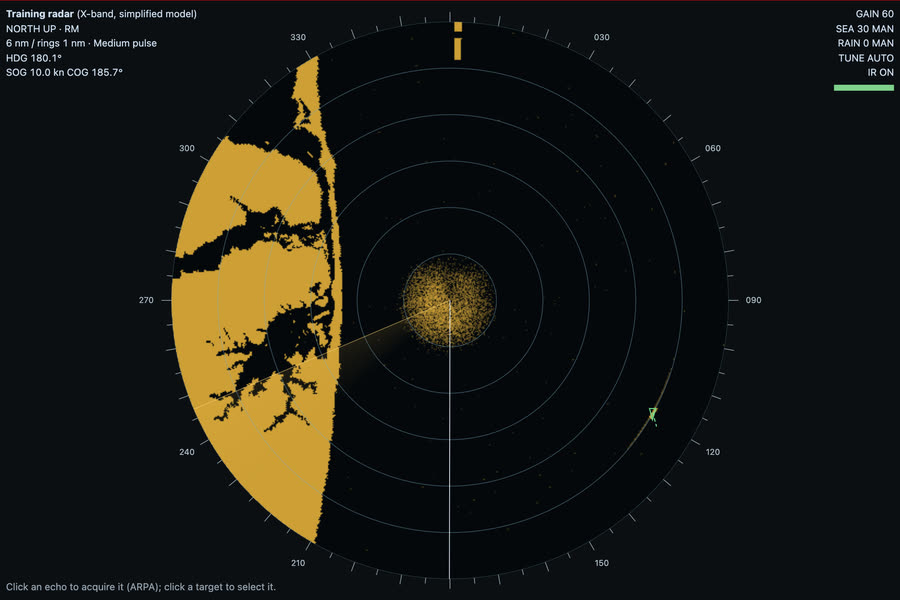
What you do on the bridge
- First bearing
- Second bearing
- Run it on along the water track
The oral questions, and what a good answer covers
The key points are in our own words. In the course, these questions come once you have done the job.
What is leeway, and how do you allow for it?Often asked
A good answer covers:
- Leeway is the angle between the heading and the track through the water, caused by the wind pushing her sideways
- It is downwind of the heading: with the wind on the starboard side she makes leeway to port
- It grows with the wind strength and the windage, and is larger at low speed
- Estimate it from the wake against the fore and aft line, or from heading and COG when there is no stream
- Allow for it in the course to steer, by heading upwind of the track wanted
Show me on the bridgeCompare the heading and the COG on the Ship tab: no stream here, so the difference is leeway.
In a running fix, along what do you run the first position line on?Often asked
A good answer covers:
- Along the course and distance made good between the two observations
- With leeway, that is the water track, the heading allowing for leeway, not the heading itself
- With a stream as well, allow for the set and drift: run it on along the ground track
- The distance is the speed made good times the interval, from the log corrected for the stream
- A running fix is only as good as the course and speed used, so label it and fix by other means when you can
Why does a motor yacht make so much leeway, and when does it matter most?
A good answer covers:
- High topsides and superstructure give a large area to the wind, with a shallow draught to resist it
- At low speed the wind has more effect relative to the water flow over the hull
- It matters most in confined water, when berthing or anchoring, and when running a fix or a DR over a long time
How the lesson runs
The tutor's narration from the lesson, step by step. On the bridge, each control lights up as it is named.
Brief
Southbound off the Jersey shore at six knots, heading one nine zero, with a near gale from the west on the starboard beam. It's slack water: no stream.
You're going to fix by a running fix on the paper chart. First, find out how much the wind is pushing her.
Find the leeway
On the ECDIS Ship tab, compare the heading and the course over the ground. With no stream, the difference is leeway.
She heads one nine zero and makes good about one eight four. That's six degrees of leeway, to port, downwind.
First bearing
At the chart table, take a bearing of Shark River light, abeam to starboard, and lay it on the chart. Note the time and the log.
Second bearing
Wait at least ten minutes, then take a bearing of Manasquan, ahead to starboard, and lay that on too.
Run it on along the water track
Now the Running fix tool. Run the first bearing on along the course she has made good through the water, about one eight four, for the distance run by the log.
Then fix from the run-on line and the second bearing.
Do it, then explain it.
Read the answers here for free. With a pass you work this lesson on the bridge, then practise its questions and mark your answers.