Compass error by a transit: the Sandy Hook range at dusk
Identify a pair of range lights, take a gyro bearing as they come in line, find the gyro error from the charted bearing, then check the standard compass.
- Phase 3: Fixing the position
- 4 steps on the bridge
- 4 oral questions
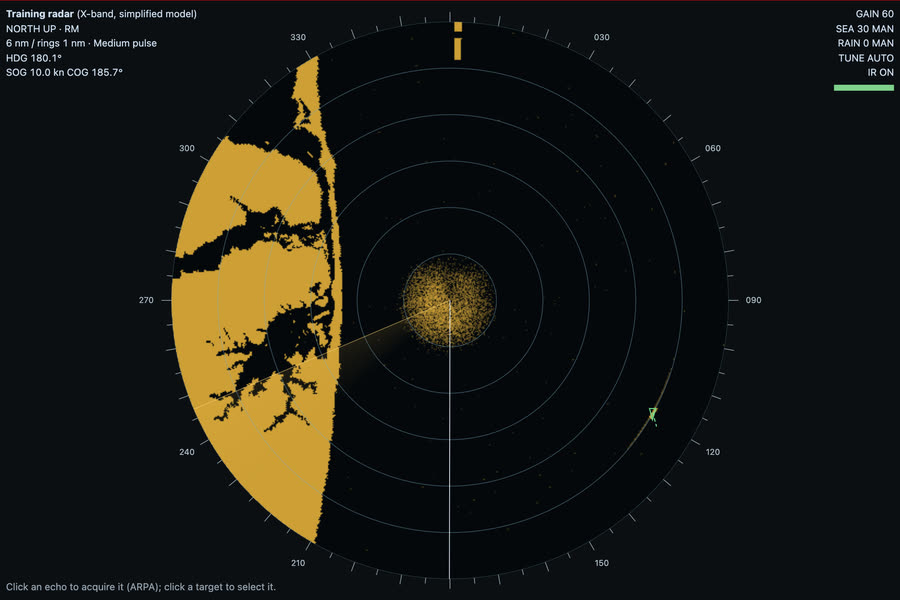
What you do on the bridge
- Identify both lights
- A bearing in transit
- Check the standard compass
- Log it
The oral questions, and what a good answer covers
The key points are in our own words. In the course, these questions come once you have done the job.
Why is a charted transit a good way to check the compass?Often asked
A good answer covers:
- The true bearing is printed on the chart, so nothing has to be worked out
- It is quick and can be done whenever two charted marks come in line, by day or by night with range lights
- It needs no celestial body, so it works in overcast weather near the coast
- Error = charted bearing less the observed bearing; east if the charted bearing is greater
Show me on the bridgeThe two range lights to starboard: watch them close until one is above the other.
What makes one transit better than another for a compass check?
A good answer covers:
- The marks well apart compared with your distance from the front mark, so the line is sensitive
- Both marks positively identified, by chart, Light List and their characteristics
- Not so close to the front mark that a small error in timing gives a large error
- Taken at the moment they are exactly in line, and repeated if in doubt
How do leading lights help you keep a channel at night?
A good answer covers:
- The rear light is higher than the front; keep them in line and you are on the leading line
- If the front light opens to the right of the rear, you are to the right of the line; steer to bring them back in line
- Often sectored or of a limited arc, so they are only seen from near the line
- Check the bearing as well, so you know it is the right pair
You have found the gyro error. What next?
A good answer covers:
- Enter it in the compass error book with the time, position and method
- Apply it to every gyro bearing and course, and tell the next watch if it has changed
- Use the corrected gyro to find the standard compass error and the deviation, and compare with the card
- A change from the usual error is looked into and reported to the master
How the lesson runs
The tutor's narration from the lesson, step by step. On the bridge, each control lights up as it is named.
Brief
We're off Sandy Hook at dusk, heading south west at four knots. To starboard is the Sandy Hook Channel range: a front light and a higher rear light, charted in line on three zero eight point two degrees.
In about two minutes we cross that line. When the two lights are exactly one above the other, a bearing of either one should read three zero eight point two. Whatever the gyro says instead is its error.
Identify both lights
Go to the starboard wing, key seven, and find the two lights low on the beam. Aim at each in turn and press T. The bearing book names them: the front light is the lower one, the rear light is higher and further off.
A bearing in transit
Now watch them close. As the lights come in line, one exactly above the other, take a bearing of the front light.
Then open the compass panel at the helm. In the error book choose Transit and the Sandy Hook range, pick that bearing, enter the charted bearing, and the gyro error: charted less observed.
Check the standard compass
With the gyro error known, check the magnetic compass the usual way: in Compass comparison, the gyro and compass readings, the variation, the card deviation and the gyro error you just found.
Log it
Last, the deck log: in the remarks, the gyro error found by the Sandy Hook range, and the compass error.
The rules and guidance behind it
- NOAA chart and US Coast Guard Light List: Sandy Hook Channel range lights
Do it, then explain it.
Read the answers here for free. With a pass you work this lesson on the bridge, then practise its questions and mark your answers.