Echo sounder and speed log
Find the wrong draught in the echo sounder, set the datum and alarm, and use water and bottom track correctly.
- Phase 1: The bridge, one piece of equipment at a time
- 5 steps on the bridge
- 4 oral questions
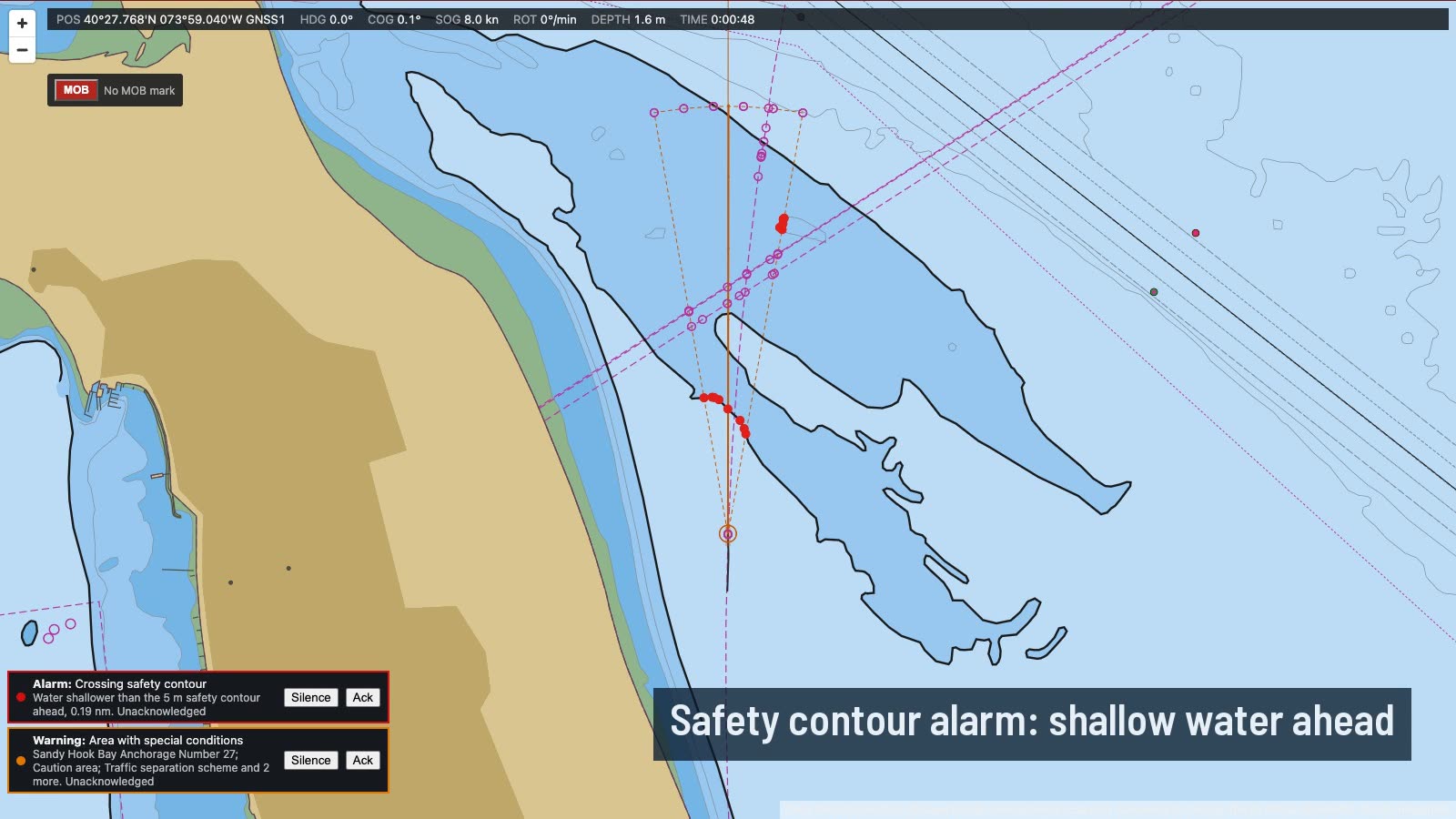
What you do on the bridge
- Check the draught entered
- Datum and shallow alarm
- Bottom track
- Water track
- The radar speed input
The oral questions, and what a good answer covers
The key points are in our own words. In the course, these questions come once you have done the job.
How does an echo sounder work, and how do you set it up?Often asked
A good answer covers:
- It times a sound pulse from the transducer to the bottom and back, using an assumed speed of sound in sea water
- It measures below the transducer; below the keel and below the waterline come from the draught and transducer depth entered
- Set the draught, the datum you want, the range and the gain, and a shallow alarm
- Check the reading against the charted depth plus the tide
Show me on the bridgeThe echo sounder as the last officer left it. Is the depth below the keel right?
What errors and false echoes can an echo sounder give?Often asked
A good answer covers:
- A wrong draught or transducer depth entered gives a wrong depth below the keel
- Aeration under the hull, in heavy weather or going astern, can lose the bottom
- Mid-water layers, fish or plankton can give false shallow readings, especially with high gain
- Multiple echoes, and second-trace echoes from a deep bottom on a short range
- On a slope it shows the nearest bottom, not the depth straight down
What is the difference between water track and bottom track on a Doppler log, and which do you use for what?Often asked
A good answer covers:
- Water track measures speed through the water, from a layer just under the hull
- Bottom track measures speed over the ground, while the bottom is in range
- Water track for collision avoidance: the radar is then sea stabilised and target aspects are true
- Bottom track for berthing and anchoring, where speed over the ground matters, often with sideways speeds at bow and stern
What other kinds of speed log are there, and what are their limits?
A good answer covers:
- Electromagnetic log: speed through the water from the voltage the flow induces; needs calibrating
- Impeller or pitot logs on small craft: fouling and wear make them under-read
- Doppler log: can give speed over the ground in shallow water, and through the water anywhere
- GNSS gives speed over the ground only, and fails with the GNSS
How the lesson runs
The tutor's narration from the lesson, step by step. On the bridge, each control lights up as it is named.
Brief
We're inbound in the channel with the flood under us. Two instruments matter here: the echo sounder, which says how much water is under the keel, and the speed log.
Both can mislead if they're set up wrong. We'll check the echo sounder's settings, set its alarm, then look at the log in water track and bottom track.
Check the draught entered
Go to the echo sounder. It measures below the transducer, and works out the depth below the keel from the draught someone typed in. Look at that draught.
It says 2.0 metres. We draw 3.9. So every depth below the keel it shows is 1.9 metres too deep. Correct it.
Datum and shallow alarm
Show the depth below the keel, since that's what touches the bottom. Then set the shallow alarm to our minimum under keel clearance, about 2 metres.
Bottom track
Now the log. Switch it to bottom track. It reads speed over the ground, and with the flood setting across us you'll see a sideways speed. That's the stream.
Water track
Back to water track. That is our speed through the water, along our heading. For collision avoidance, that is the one we want.
The radar speed input
The radar is taking its speed from GNSS, over the ground. In a stream like this, true vectors then show where ships go over the ground, not which way they are heading, and their aspect looks wrong.
Set the radar speed input to the log, in water track. The radar is then sea stabilised, right for judging other ships.
Do it, then explain it.
Read the answers here for free. With a pass you work this lesson on the bridge, then practise its questions and mark your answers.