GNSS errors and spoofing
Spot a GNSS receiver walking away from the truth, cross-check, change the primary, and report it.
- Phase 3: Fixing the position
- 5 steps on the bridge
- 4 oral questions
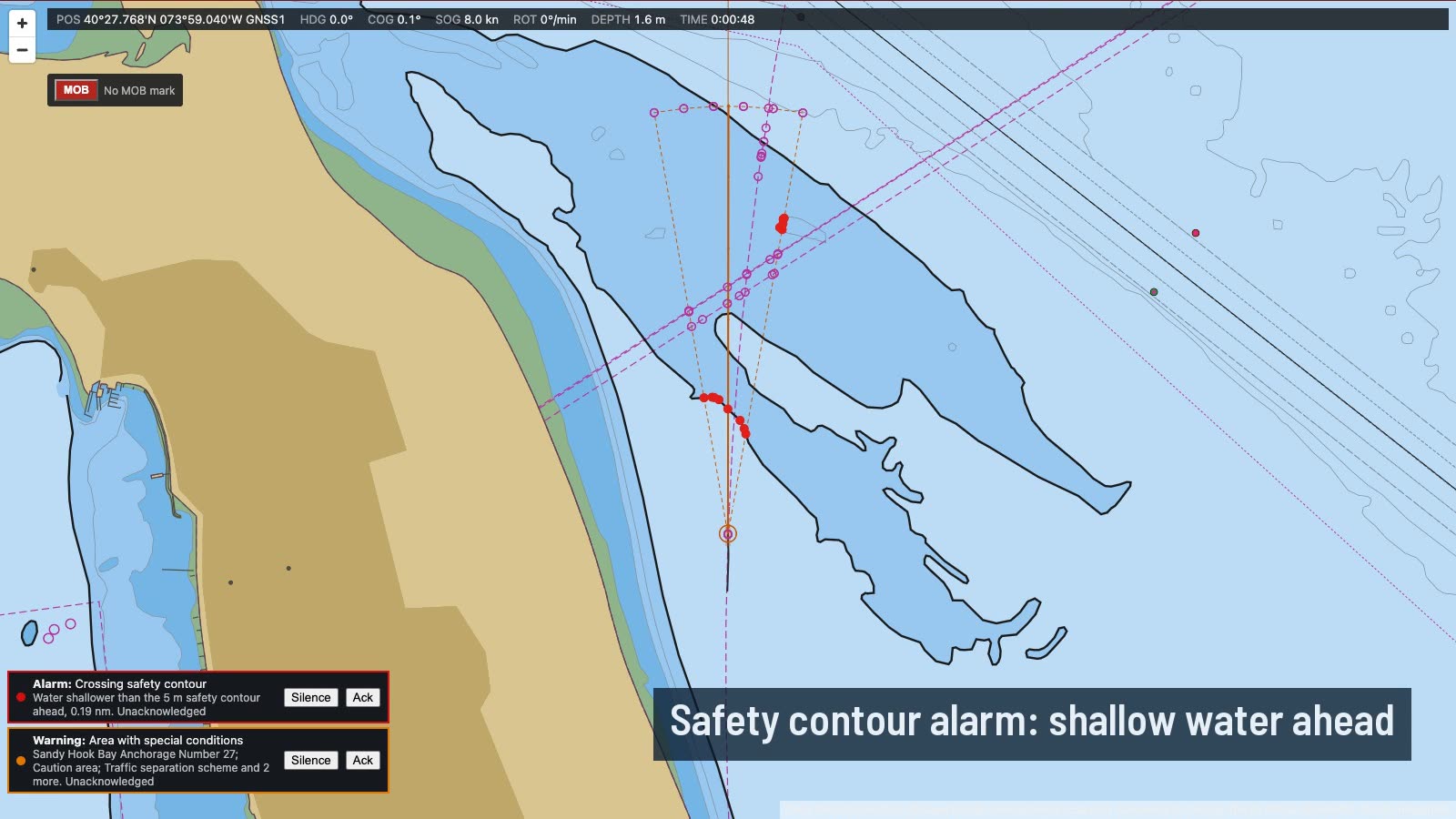
What you do on the bridge
- The two receivers disagree
- Cross-check by another means
- Change the primary
- Tell the master
- Log it
The oral questions, and what a good answer covers
The key points are in our own words. In the course, these questions come once you have done the job.
What errors affect a GNSS position, and how do you know how good it is?Often asked
A good answer covers:
- Satellite geometry: a high HDOP means a poorer fix
- Ionospheric and tropospheric delays, multipath near large structures, and receiver noise
- Jamming and spoofing, which can give no fix or a wrong one with a good status
- Datum: the position must be on the same datum as the chart, usually WGS 84
- Watch the status, number of satellites and HDOP, and always cross-check by other means
How might you detect that the GNSS is being spoofed, and what would you do?Often asked
A good answer covers:
- The two receivers disagree, or the ECDIS position no longer matches the radar picture or visual bearings
- The echo sounder disagrees with the charted depth, or speed and course over the ground look odd
- Change to the good receiver or to dead reckoning with radar and visual fixes
- Do not let the autopilot or track control follow a false position
Show me on the bridgeWatch the secondary difference in the Sensors tab as GNSS 1 starts to walk away.
What are differential GNSS and SBAS, and what do they give you?
A good answer covers:
- A reference station at a known position measures the errors and broadcasts corrections
- Differential GNSS sends them by radio beacon; SBAS sends them from geostationary satellites
- Better accuracy, and integrity warnings when a satellite is unhealthy
- Corrections only help while they are received: check the receiver shows a differential or SBAS fix, not a plain one
What is eLoran, and what errors does it suffer?
A good answer covers:
- A low frequency terrestrial radio navigation system, independent of satellites
- Ground wave propagation, so useful as a back-up if GNSS is jammed
- Errors from the signal travelling over land, which slows it, and from sky waves at night
- Corrections from reference stations (differential eLoran) improve it; coverage depends on the stations in service, and several national services have closed
How the lesson runs
The tutor's narration from the lesson, step by step. On the bridge, each control lights up as it is named.
Brief
We're inbound on the autopilot with two GNSS receivers. GNSS 1 is the primary. The ECDIS compares it with GNSS 2 all the time.
Look at the Sensors tab: the datum, the satellites, the HDOP and the difference between the two. Then keep a lookout. If they start to disagree, we find out which one to believe.
The two receivers disagree
There it is: primary and secondary positions disagree. GNSS 1 still says its fix is good. That's what spoofing looks like.
Acknowledge the alarm. Then find out which receiver is lying.
Cross-check by another means
Prove it by something that doesn't use satellites. Take bearings of charted marks from the wing, or put a radar range and bearing of a buoy on the ECDIS as a position line.
Change the primary
The cross-check agrees with GNSS 2, so GNSS 1 is the one walking away. Make GNSS 2 the primary position source. The autopilot and the ECDIS now follow the good receiver.
Tell the master
Call the master and tell him what's happened, and what you've done about it.
Log it
Enter it in the deck log: the time, GNSS 1 disagreeing, how you checked, and the change to GNSS 2.
The rules and guidance behind it
- MGN 379 (M+F) Amendment 1: use of electronic navigational aids
Do it, then explain it.
Read the answers here for free. With a pass you work this lesson on the bridge, then practise its questions and mark your answers.