COLREGs in sight: a give-way ship that does not, then head-on
Stand on for a ship crossing from port, give the doubt signal, act without turning to port; then alter to starboard for a ship head-on.
- Phase 4: Collision avoidance
- 8 steps on the bridge
- 5 oral questions
What you do on the bridge
- Is there risk of collision?
- Stand on
- The doubt signal
- Act, but not to port
- Past and clear
- The ship ahead
- Alter to starboard
- Back on course
The oral questions, and what a good answer covers
The key points are in our own words. In the course, these questions come once you have done the job.
You are the stand-on vessel and the give-way vessel is not taking action. What do you do, and when?Often asked
A good answer covers:
- Rule 17(a)(i): keep your course and speed at first
- Sound at least five short and rapid blasts as soon as it is in doubt that she is taking enough action (Rule 34(d)), and you may add a light signal
- Rule 17(a)(ii): you may then take action on your own to avoid collision, as soon as it is apparent she is not acting
- Rule 17(b): when collision cannot be avoided by her action alone, you must take the action that best helps
- Rule 17(c): for a vessel crossing from your port side, do not alter course to port if you can help it
- Taking action does not relieve the give-way vessel of her duty to keep out of the way (Rule 17(d))
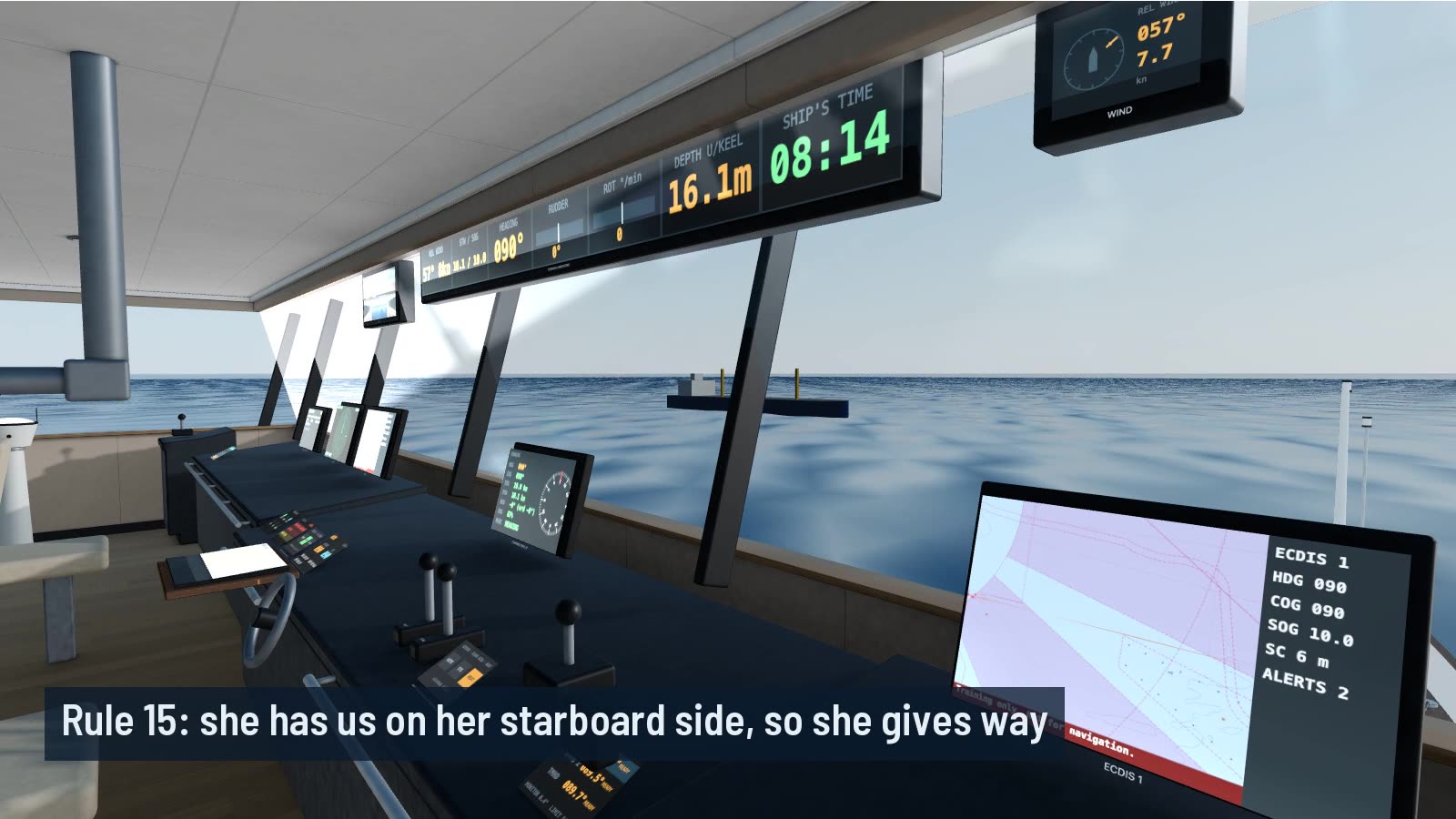
Show me on the bridgeThe coaster on the port bow is the give-way vessel. Watch her bearing.
When is it a head-on situation, and what does each vessel do?Often asked
A good answer covers:
- Two power-driven vessels meeting on reciprocal or nearly reciprocal courses, with risk of collision
- By day you see the other ship ahead or nearly ahead, her masts in line or nearly in line; by night her masthead lights in line and both sidelights
- When in doubt whether it is head-on, assume it is and act accordingly
- Each alters course to starboard, so that each passes on the port side of the other
- Make the alteration early and large enough to be obvious, with one short blast when in sight
Show me on the bridgeFar ahead, a ship coming the other way. What does she show you?
When is one vessel overtaking another, and who keeps out of the way?Often asked
A good answer covers:
- Coming up with another vessel from more than 22.5 degrees abaft her beam: by night she would see only the sternlight
- The overtaking vessel keeps out of the way of the one being overtaken, whatever kind of vessel either is
- In doubt, assume you are overtaking
- A later change in the bearing does not make it a crossing situation: the duty stays until she is finally past and clear
- In a narrow channel the overtaking signals of Rule 34(c) apply when the other vessel has to act to allow her to pass
What are the manoeuvring and warning signals for vessels in sight of one another?
A good answer covers:
- One short blast: I am altering my course to starboard
- Two short blasts: I am altering my course to port
- Three short blasts: I am operating astern propulsion
- At least five short and rapid blasts: I do not understand your intentions, or doubt you are taking enough action
- One prolonged blast near a bend or obstruction, answered by one prolonged blast
- A short blast is about one second, a prolonged blast four to six seconds
What makes action to avoid collision good action under Rule 8?
A good answer covers:
- Positive, made in ample time, and in keeping with good seamanship
- Large enough to be readily apparent to the other vessel by eye or radar: avoid a series of small alterations
- An alteration of course alone may be best in open water, if made in good time and it does not cause another close-quarters situation
- It must result in passing at a safe distance; check it until the other vessel is finally past and clear
- Slow down, stop or go astern if more time is needed
How the lesson runs
The tutor's narration from the lesson, step by step. On the bridge, each control lights up as it is named.
Brief
We're heading east at ten knots in good visibility. There's a coaster on the port bow, about three and a half miles off, and a bigger ship a long way ahead.
We'll work out who gives way, and do what the rules ask of us. The ships out there will hold their course whatever we do, so it's all on us.
Is there risk of collision?
Put EBL 1 on the coaster and acquire her on ARPA. Wait for the track to settle.
Her bearing isn't changing and the range is closing: there is risk of collision. She's crossing from our port side, so she is the give-way vessel and we are the stand-on vessel.
Stand on
As the stand-on vessel, keep our course and speed. Changing them now could confuse her, just as she decides to act. Keep watching her bearing and her aspect.
The doubt signal
Two miles, and she hasn't changed a thing. Wake her up: at least five short and rapid blasts on the whistle. That means I doubt you are taking enough action.
Act, but not to port
Still nothing. Rule seventeen lets us act on our own now. She's on our port side, so don't alter to port: that turns us towards her as she comes on.
Alter boldly to starboard, about two hundred, so she draws round onto our port quarter. Give one short blast as you turn, and watch the CPA open past a mile.
Past and clear
Keep her under watch until she's past and clear. Then come back to zero nine zero.
The ship ahead
Now the ship ahead. Acquire her and look at her vector. She is coming straight towards us on the reciprocal course.
If you could see her masts, they'd be in line. That's a head-on situation, and in any doubt we treat it as one.
Alter to starboard
In a head-on situation, both ships alter to starboard and pass port to port. Do it early, while she is still a few miles off, and make it big enough to see. One short blast as you turn.
Back on course
Hold the new course until she's past and clear, then come back to zero nine zero.
Do it, then explain it.
Read the answers here for free. With a pass you work this lesson on the bridge, then practise its questions and mark your answers.