Restricted visibility: when the fog comes in
Fog signal, lights, hand steering, a safe speed, radar plotting and the deck log, all within minutes of the fog.
- Phase 4: Collision avoidance
- 6 steps on the bridge
- 5 oral questions
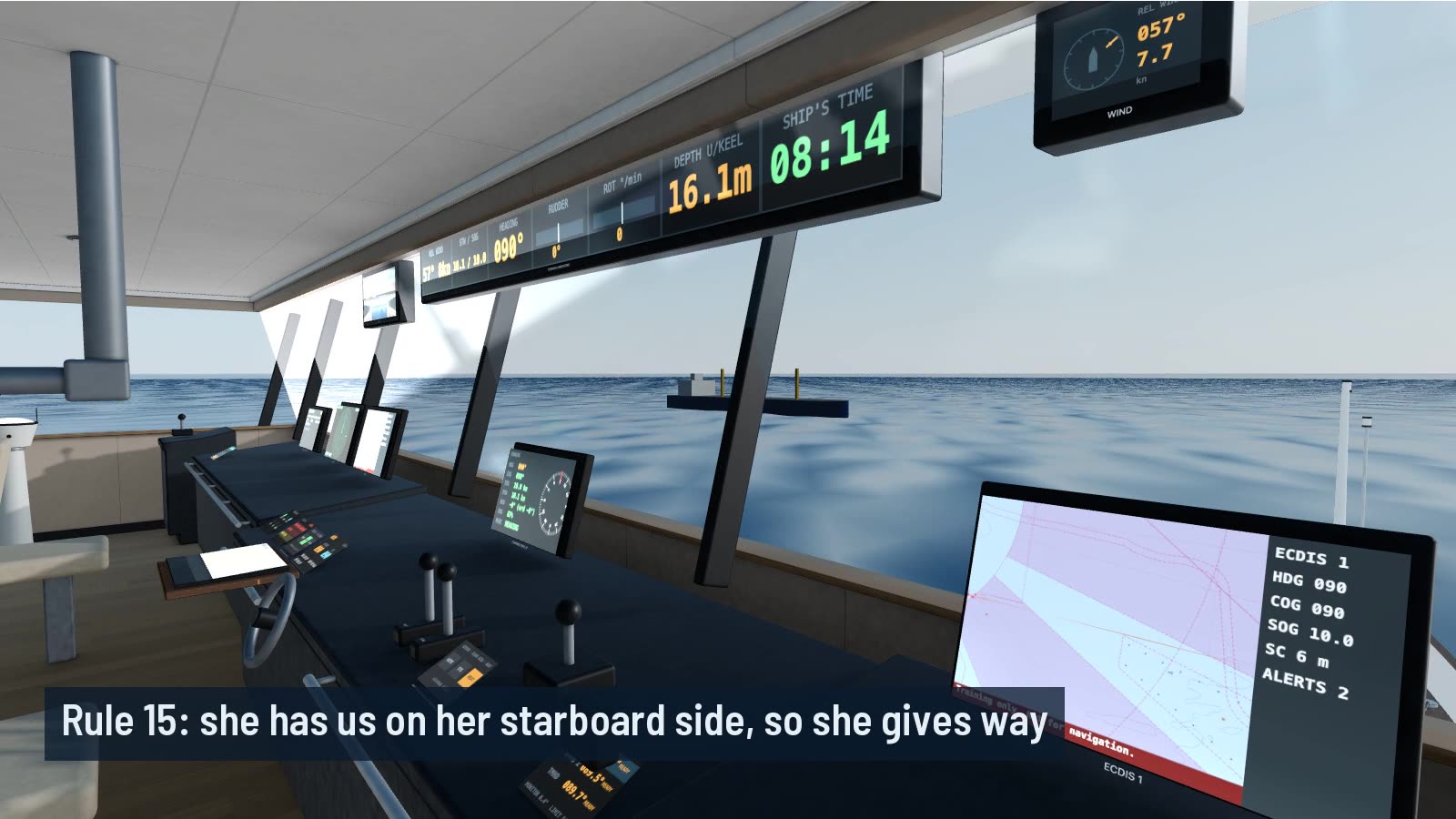
What you do on the bridge
- Fog signal
- Navigation lights
- Hand steering
- Safe speed
- Radar plotting
- Deck log
The oral questions, and what a good answer covers
The key points are in our own words. In the course, these questions come once you have done the job.
You are on watch and the visibility closes in. What do you do?Often asked
A good answer covers:
- Call the master, as the standing orders require
- Start the right fog signal for the vessel, and keep listening for others
- Navigation lights on, whatever the time of day
- Proceed at a safe speed for the conditions, with the engines ready for immediate manoeuvre
- Hand steering, and post extra lookouts, including one placed to listen
- Both radars running, targets plotted on ARPA, and the position fixed more often
- Close watertight doors where fitted, and write it all in the deck log
Show me on the bridgeThe fog bank is ahead and will close in within two minutes. Say what you would do, in order.
Give me the fog signals for a power-driven vessel, a vessel not under command, and a vessel at anchor.Often asked
A good answer covers:
- Power-driven making way: one prolonged blast at intervals of not more than two minutes
- Power-driven under way but stopped: two prolonged blasts in succession, at not more than two minutes
- Not under command, restricted in her ability to manoeuvre, constrained, sailing, fishing or towing: one prolonged then two short, at not more than two minutes
- At anchor: the bell rung rapidly for about five seconds at intervals of not more than one minute; at 100 metres or more, the bell forward and then the gong aft
You detect a vessel by radar alone, forward of the beam and closing. What does Rule 19 say about your action?Often asked
A good answer covers:
- Decide whether a close-quarters situation is developing or risk of collision exists
- If so, take avoiding action in good time
- Avoid an alteration to port for a vessel forward of the beam, other than one being overtaken
- Avoid an alteration towards a vessel abeam or abaft the beam
- The steering and sailing rules for vessels in sight of one another do not apply here: there is no stand-on vessel
You hear a fog signal apparently forward of the beam, and you cannot see the vessel. What now?
A good answer covers:
- Unless you have found that risk of collision does not exist
- Reduce speed to the minimum at which you can keep your course
- Take all way off if necessary
- Navigate with extreme caution until the danger of collision is over
What decides a safe speed in fog?
A good answer covers:
- The visibility, and the traffic density, including fishing vessels
- How quickly the vessel can stop and turn in the conditions
- Background light at night, the wind, sea and current, and nearby dangers
- Draught against the depth of water
- The radar: its range scale, its limits, small targets lost in clutter, and how many targets it shows
- A speed at which she can stop within the distance you can see is a good rule of thumb, though the rules give no figure
How the lesson runs
The tutor's narration from the lesson, step by step. On the bridge, each control lights up as it is named.
Brief
We're inbound on the approach at twelve knots, and there's a fog bank ahead. In about two minutes the visibility will drop to under half a mile.
When it does, the clock starts. Fog signal within two minutes. Then lights, hand steering, a safe speed and a radar target on the ARPA within five. The deck log within ten.
Fog signal
First, let others hear us. We're power-driven and making way, so the signal is one prolonged blast at intervals of no more than two minutes.
Set the automatic fog signal to making way. If we stop, it must change to two prolonged blasts.
Navigation lights
It's daytime, but the lights rule applies in restricted visibility too. Switch on the lights for a power-driven vessel under way: two masthead lights, sidelights and sternlight, and nothing else.
Hand steering
Take her off the autopilot. In restricted visibility we want a helmsman on the wheel, so a course alteration is immediate and nobody has to remember how to disengage the pilot in a hurry.
Safe speed
Twelve knots in half a mile of visibility, with traffic about, is too fast. Bring her down to eight knots or less here. A safe speed is one where we can stop in good time for what we might meet.
Radar plotting
Now the radar does the looking for us. Acquire at least one target on the ARPA, so we have its closest point of approach and the time to it. Scanty radar information is a dangerous thing to act on, so plot properly.
Deck log
Last, write it down. A deck log entry with the weather, including the reduced visibility, and the time it came in. If anything goes wrong later, this is the record of what we knew and when.
The rules and guidance behind it
- COLREG Rule 19: conduct of vessels in restricted visibility
- COLREG Rule 35: sound signals in restricted visibility
- COLREG Rule 6: safe speed
- COLREG Rule 20: application of the lights rules
Do it, then explain it.
Read the answers here for free. With a pass you work this lesson on the bridge, then practise its questions and mark your answers.