Radar plotting: the relative motion triangle
Plot a crossing ship by hand from three observations, find her CPA, course, speed and aspect, and the effect of our alteration.
- Phase 4: Collision avoidance
- 5 steps on the bridge
- 5 oral questions
What you do on the bridge
- Three observations
- CPA and TCPA
- Her true course and speed
- Her aspect
- Effect of our alteration
The oral questions, and what a good answer covers
The key points are in our own words. In the course, these questions come once you have done the job.
Draw me the relative motion triangle and tell me what each side means.Often asked
A good answer covers:
- O is the first plotted position of the target, A the position after the plotting interval
- OA is her relative motion; run it on past A and its closest pass of own ship is the CPA
- WO is own ship course and speed over the interval, laid off back from O
- WA is her true course and speed over the same interval
- The interval must be the same for every side, and own course and speed steady during it
Show me on the bridgeThe coaster on the starboard bow. Take your first observation off EBL 1 and VRM 1.
How many observations do you want before you decide anything from a plot, and why?Often asked
A good answer covers:
- At least three where there is time, a few minutes apart
- They show whether she is steady on her course and speed: plots in a straight line, evenly spaced
- One observation tells you nothing about her motion, and two cannot show that she is changing
- Assumptions on scanty information, especially scanty radar information, are what the rules warn against
On the plot, how do you work out what an alteration of course or a reduction of speed will do?Often asked
A good answer covers:
- Keep W and A where they are: her true motion does not change because we alter
- Lay off our new course and speed from W to give O prime
- Her new relative motion runs from A parallel to O prime A; its closest pass is the new CPA
- Slowing down shortens WO, so O prime moves towards W; altering swings O prime round W
What is aspect, and what does red thirty tell you?
A good answer covers:
- Aspect is our bearing from the other ship, measured from her heading, red or green
- Red thirty: we are thirty degrees on her port bow
- So she will be showing us her red sidelight at night, and her masthead lights a little open
- It tells us how she sees us, which helps work out which rule applies
What can make a radar plot wrong?
A good answer covers:
- Wrong own course or speed on the plot, which spoils her true course and speed but not the CPA
- Poor bearings or ranges, and too short a plotting interval
- Own ship or the target altering during the plot
- Through the water against over the ground: in a tide the true vector and aspect can mislead
How the lesson runs
The tutor's narration from the lesson, step by step. On the bridge, each control lights up as it is named.
Brief
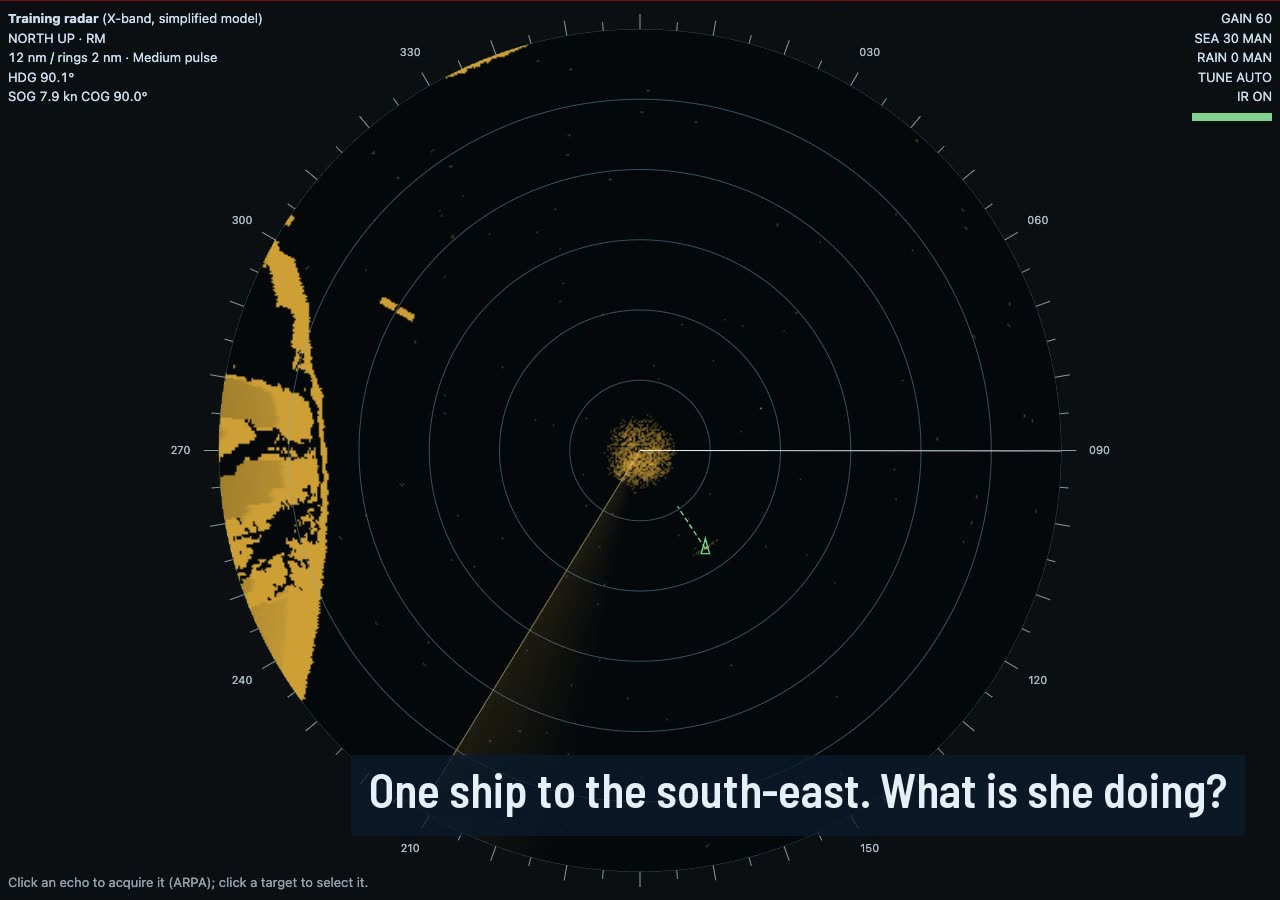
We're heading east at eight knots in clear weather. There's a coaster on the starboard bow, about six and a half miles off, and she has no AIS.
We'll plot her by hand, the way you would if the ARPA failed. Three observations, the triangle, then her CPA, her course and speed, her aspect, and what an alteration would do. Open the radar and find the plotting sheet.
Three observations
Put EBL 1 and VRM 1 on her echo and take an observation. That puts O on the sheet. Then wait three minutes, lay them on her again and observe, and again three minutes later.
Each reading has to be within three degrees and a third of a mile of where she really is, and the plot has to run at least three minutes. Watch the plots: in a straight line and evenly spaced means she's steady.
CPA and TCPA
The sheet joins O to A and runs the line on. That line is her relative motion. Where it passes closest to the centre is the CPA. Measure it with the ruler: click the centre, then the closest point.
For the TCPA, measure from A to that closest point and divide by her relative speed, which is O to A over the plotting time. We need the CPA within three cables and the time within three minutes, counted from A.
Her true course and speed
W is laid back from O by our own run over the plot. W to A is what she is really doing. Measure W to A with the ruler: its direction is her course, and its length over the plotting time is her speed.
Check our course and speed on the sheet first. Get those wrong and her true motion is wrong too, even though the CPA is not. We need her course within fifteen degrees and her speed within two knots.
Her aspect
Aspect is our bearing from her, measured from her heading, red if we're on her port side and green if we're on her starboard side. Take the reciprocal of her bearing from us at A, and compare it with her course. Within twenty degrees, and the right colour.
Effect of our alteration
She's crossing from starboard and we're the give-way ship. Try an alteration to starboard on the sheet: enter the new course. The sheet lays our new vector from W to O prime, and her new relative motion runs from A, parallel to O prime A.
Measure the new CPA with the ruler. We want at least a mile, read off within three cables. Then hand the plot in.
The rules and guidance behind it
- COLREG Rule 7: risk of collision (systematic observation, no scanty information)
- COLREG Rule 8: action to avoid collision
Do it, then explain it.
Read the answers here for free. With a pass you work this lesson on the bridge, then practise its questions and mark your answers.