Plan the passage in from sea
Make and check the route on the ECDIS, work depths, clearance, reporting points and contingencies from the publications, and hand the plan to the master.
- Phase 5: Passage planning and keeping the watch
- 4 steps on the bridge
- 4 oral questions
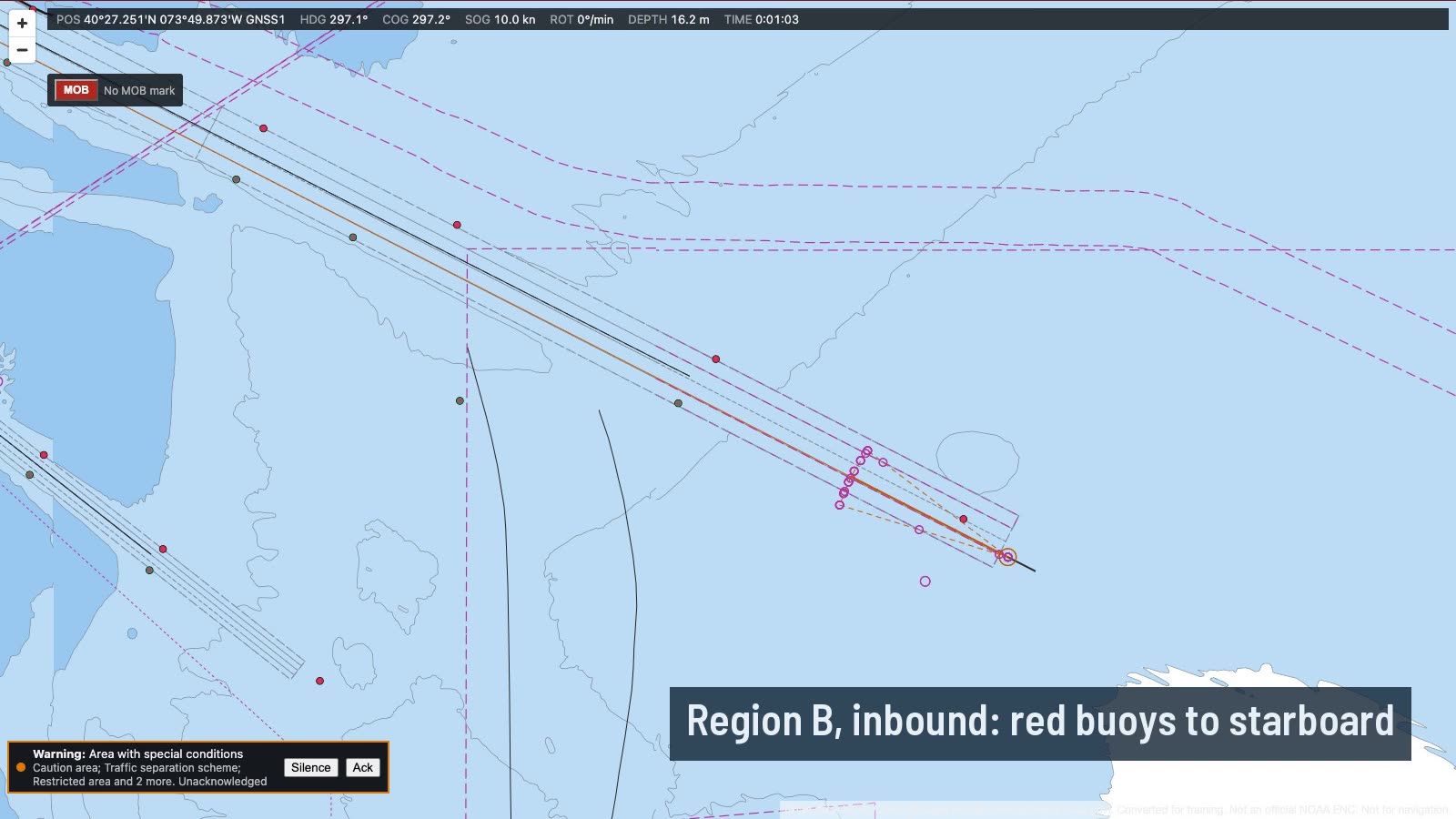
What you do on the bridge
- Route, route check and appraisal
- Depths and clearance
- Reporting points
- Abort, contingency, window and fixes
The oral questions, and what a good answer covers
The key points are in our own words. In the course, these questions come once you have done the job.
What are the stages of a passage plan? Tell me what goes in each.Often asked
A good answer covers:
- Appraisal: gather everything relevant from charts, notices, tide tables, lights, pilot book, radio list, weather and the ship's own condition
- Planning: the route on the chart, with courses, distances, safe depths, no-go areas, reporting points, abort points and contingencies
- Execution: timing, the tidal window, the expected weather and traffic, when to call the master or the pilot
- Monitoring: how and how often the position is fixed, parallel indexes, clearing lines, checks on the plan
- Berth to berth, approved by the master before sailing
Show me on the bridgeStopped east of the Ambrose buoy, waiting to go in. Look at the approach you will plan.
How do you work the under keel clearance and the no-go depth for a leg?Often asked
A good answer covers:
- Under keel clearance is the charted depth plus the height of tide relied on, less the draught
- It must be at least what the master or the company requires
- The no-go depth is the draught plus the clearance required, less the tide relied on
- Anything charted shallower than that is no-go, and is shaded or marked on the chart
- If you rely on the tide, you must also give the window it holds for
What is an abort point, and why does a plan need contingencies?
A good answer covers:
- The last point at which you can safely turn back or stop before committing to a narrow passage
- Chosen with the ship's turning circle and the depths and traffic in mind
- Contingencies cover failures and changes: an anchorage you can reach, an alternative route, emergency berths
- They are planned in advance, so the decision under pressure is already made
How do you decide the fix interval in pilotage waters?
A good answer covers:
- Often enough that the ship cannot run into danger between fixes
- Use more than one method, and cross check the ECDIS with radar and visual fixes
- Shorten it further near dangers, in poor visibility or with a strong cross stream
How the lesson runs
The tutor's narration from the lesson, step by step. On the bridge, each control lights up as it is named.
Brief
We're stopped two miles east of the Ambrose buoy, waiting to go in to the Narrows. Before we move, there has to be a plan the Master has checked.
We'll make the route on the ECDIS and check it, then fill in the passage plan from the chart, the tide tables and the pilot book, in four stages. Each time you hand it to the Master, you'll see what passes and what needs another look.
Route, route check and appraisal
Look down at the ECDIS and make the route in route planning, from here to the Narrows. Run the route check, and acknowledge its results. An unchecked route is just a line on a screen.
Then at the chart table open Passage plan, and in Appraisal tick each publication as you actually use it. The legs in the plan come from the route, so they must match it.
Depths and clearance
Enter our draught from the ship's particulars and the clearance the Master's standing orders require. For each leg, find the least charted depth on the chart, and work the clearance: depth, plus any tide you rely on, less the draught.
Then the no-go depth: draught plus required clearance, less the tide relied on. Every leg must have at least the clearance required.
Reporting points
Open the pilot book and find the VTS reporting points. Tick every one that lies on our route, and only those. Missing a report in a busy port is a quick way to upset the VTS and the Master.
Abort, contingency, window and fixes
Choose an abort point, the last waypoint where we can still turn back, and a contingency anchorage from the pilot book. If you rely on the tide, give the window, in UTC, that it holds for.
Set a fix interval for pilotage waters, six minutes or less here. Then hand the plan to the Master, and put right anything the check marks.
Do it, then explain it.
Read the answers here for free. With a pass you work this lesson on the bridge, then practise its questions and mark your answers.