Helm orders to a helmsman
Put a helmsman on a course, give rudder orders, hear them repeated and reported, steady her and bring her back.
- Phase 6: Emergencies and ship handling
- 5 steps on the bridge
- 4 oral questions
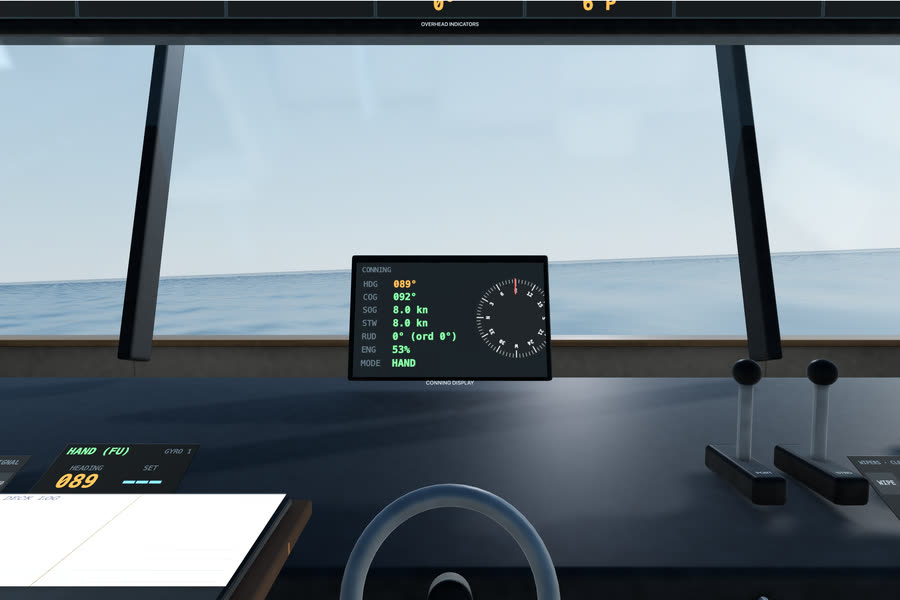
What you do on the bridge
- Put him on a course
- Starboard ten
- Midships
- Steady
- Back to the course
The oral questions, and what a good answer covers
The key points are in our own words. In the course, these questions come once you have done the job.
How do you give a helm order, and what should the helmsman do?Often asked
A good answer covers:
- Give it clearly in the standard words: the side and the angle, such as starboard ten, or midships, or a course to steer
- The helmsman repeats it back word for word straight away, so you know it was heard correctly
- He reports when the wheel is at the angle ordered, and when she is steady on the course
- You check it on the rudder indicator and the heading, and acknowledge the report
- Courses are given digit by digit, such as two seven zero, so they cannot be misheard
Show me on the bridgeAt the steering stand: the helm orders, and what the helmsman says back.
What is the difference between "midships", "steady" and "steer two seven zero"?Often asked
A good answer covers:
- Midships puts the rudder amidships; she keeps swinging for a while
- Steady means check her swing and hold the heading she has when the order is given; he reports the heading
- Steer two seven zero is a course to steer: he brings her to it and holds it, and reports when on course
- Hard a port or hard a starboard is full rudder, kept for when it is needed
When would you put a helmsman on the wheel instead of the autopilot?
A good answer covers:
- In confined or busy water, in narrow channels and harbour approaches, and when manoeuvring
- In restricted visibility or heavy traffic, so the officer is free to keep the look-out and the radar
- When the Master or the SMS requires it, and when the autopilot cannot hold her in the weather
- Change over in good time, with the helmsman told the course and the gyro and rudder indicator checked
A strong wind is on the beam. What does it do to her, and how does the helmsman steer?
A good answer covers:
- She makes leeway: her track over the ground is downwind of her heading
- Most ships tend to turn into or away from the wind depending on where the windage is, so the helmsman carries a little rudder to hold the heading
- Steering a course holds the heading, not the track: the officer allows for leeway and set in the course given
- At low speed the wind has more effect, so keep enough speed for steerage
How the lesson runs
The tutor's narration from the lesson, step by step. On the bridge, each control lights up as it is named.
Brief
Open water, heading east at eight knots, a fresh breeze from the north on the port beam. She's in hand steering, and you have a helmsman at the wheel.
You give the orders, he repeats each one back, and he tells you when the wheel is where you asked. Listen for both.
Put him on a course
At the steering stand, under helm orders, tell him to steer zero nine zero. He will repeat it, and hold her on it against the wind.
Starboard ten
Now order starboard ten. Listen for him to repeat it, then for 'wheel's starboard ten' when the rudder gets there.
Midships
She's swinging to starboard. Order midships, and wait for 'wheel's amidships'. She'll keep swinging a little.
Steady
When her head is round to about one one zero, order steady. He'll check the swing and tell you the heading he's steadied on.
Back to the course
Now bring her back: steer zero nine zero. Wait for 'course zero nine zero', and acknowledge it.
Do it, then explain it.
Read the answers here for free. With a pass you work this lesson on the bridge, then practise its questions and mark your answers.