Squat and under keel clearance
Run over shallow water at speed, see the clearance under the keel shrink, and slow her down to get it back.
- Phase 6: Emergencies and ship handling
- 1 steps on the bridge
- 3 oral questions
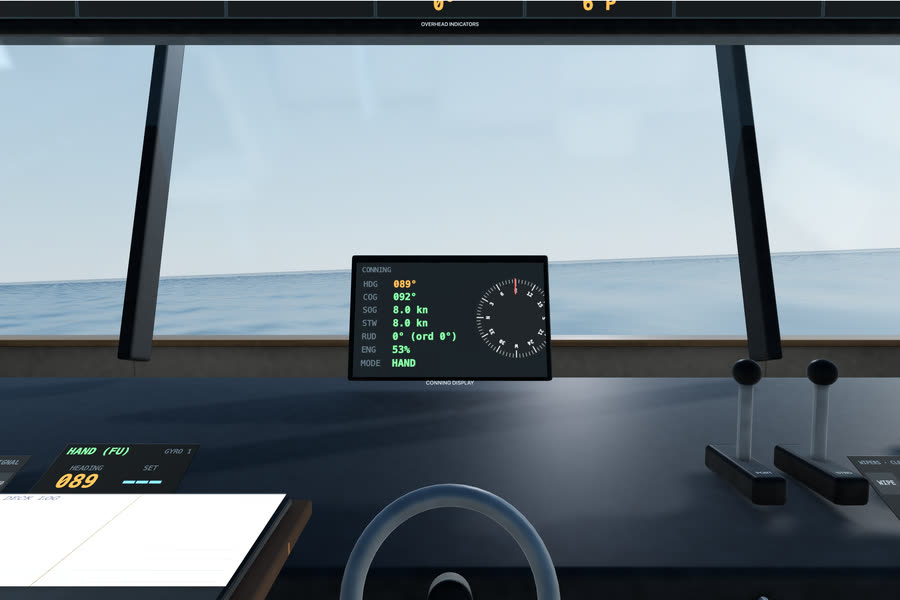
What you do on the bridge
- Slow down
The oral questions, and what a good answer covers
The key points are in our own words. In the course, these questions come once you have done the job.
What is squat, and why does it happen?Often asked
A good answer covers:
- The ship sits lower in the water when she moves through shallow water, so the under keel clearance gets less
- Water speeds up as it flows past and under the hull, and the pressure there falls, so she is drawn down
- It grows with the square of the speed: double the speed and the squat is about four times as much
- It is worst where the depth is less than about twice the draught, and worse still in a narrow channel
- A full-bodied ship (high block coefficient) squats more, and usually by the bow; a fine-lined one less, often by the stern
Show me on the bridgeOpen the echo sounder and watch the depth under the keel at 12 knots, then slow down.
How would you estimate squat, and what do you do about it?Often asked
A good answer covers:
- A rule of thumb: block coefficient times speed in knots squared, divided by one hundred, in metres, for open water; about double that in a confined channel
- Use the ship's own squat figures or tables when she has them
- Allow for it in the under keel clearance in the passage plan, with the tide
- Reduce speed in shallow water: it is the one thing that cuts squat quickly
What are the signs that a ship is in shallow water and squatting?
A good answer covers:
- The echo sounder shows less water under the keel than the chart and the tide would give
- She loses speed for the same engine power, and vibration may increase
- She becomes sluggish to steer and her turning circle grows
- The wave pattern changes: a bigger wash and stern wave
How the lesson runs
The tutor's narration from the lesson, step by step. On the bridge, each control lights up as it is named.
Brief
Raritan Bay, on a stretch charted at six metres. She draws three point nine, so at rest there are about two metres under the keel.
The depth is less than twice the draught, and you're doing twelve knots. That's where squat bites.
Read the echo sounder
At the nav station, look at the echo sounder: depth under the keel. It's about one and a half metres, not two. She's squatting about half a metre at this speed.
Slow down
Bring her down to about six knots on the telegraph. Squat goes with the square of the speed, so halving the speed cuts it to about a quarter.
Under keel clearance
Look at the echo sounder again: nearly two metres under the keel now, from the same water.
In the passage plan, the under keel clearance allows for the tide, the squat at your planned speed, and a margin. Know your own figures.
Do it, then explain it.
Read the answers here for free. With a pass you work this lesson on the bridge, then practise its questions and mark your answers.