Steering gear test before departure
Test each pump, each control system, local control and the alarms, then leave it ready for sea.
- Phase 1: The bridge, one piece of equipment at a time
- 8 steps on the bridge
- 4 oral questions
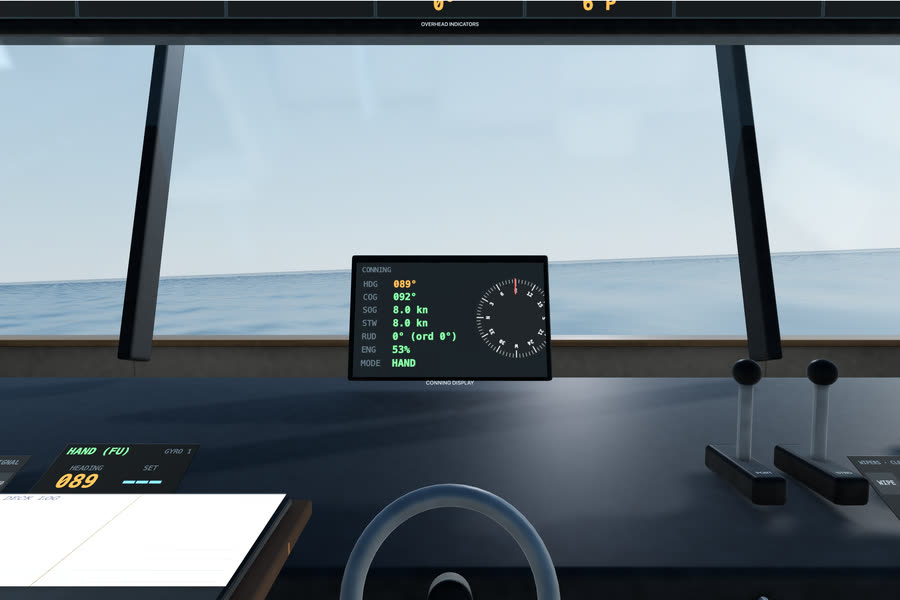
What you do on the bridge
- Pump 1 alone
- Power failure alarm
- Pump 2 alone, then both
- Each control system
- Non-follow-up tiller
- Autopilot
- Local control
- Ready for sea
The oral questions, and what a good answer covers
The key points are in our own words. In the course, these questions come once you have done the job.
When must the steering gear be tested, and what goes in the test?Often asked
A good answer covers:
- Each pump alone, and both together where they can run together
- Full movement both ways, hard over to hard over, and the time taken
- Each remote control system, and the emergency or local control
- The rudder angle indicator agrees with the actual rudder angle
- The power unit failure and control system alarms
- Entered in the deck log
Show me on the bridgeStopped before departure, with the steering test ahead of you.
How often are emergency steering drills held, and what do they practise?Often asked
A good answer covers:
- Direct control from the steering gear compartment
- The communication procedure between the bridge and the steering gear room
- Operating the alternative power supply where fitted
- The date and details entered in the log
What does the rule say about how fast the main steering gear must move the rudder?
A good answer covers:
- From 35 degrees one side to 30 degrees the other
- In no more than 28 seconds
- At the deepest seagoing draught and full ahead service speed
- Auxiliary gear: 15 degrees one side to 15 the other in not more than 60 seconds, at the deepest seagoing draught and at half speed or 7 knots, whichever is greater
The test is done. How do you leave the steering for sea?
A good answer covers:
- Both pumps running where the rules or the master require it in pilotage and confined waters
- Bridge control on the normal control system
- Hand steering until clear, autopilot only in open water
- Rudder midships and the indicator checked
- The test and its result in the deck log
Show me on the bridgeLook at the steering panel and say how you would leave it.
How the lesson runs
The tutor's narration from the lesson, step by step. On the bridge, each control lights up as it is named.
Brief
Before we sail I test the steering gear. If it fails in a narrow channel there is very little time, so we prove every part of it now, while we're stopped.
We'll run each pump on its own, then both, try each control system, the tiller, the autopilot and local control, and check the alarm. Then we leave it set for sea.
Pump 1 alone
Start with pump 1 on its own. Put the wheel hard over to port, then hard over to starboard, at least thirty degrees each way, and watch the rudder indicator follow.
Power failure alarm
During the test, power to pump 1 is cut. That's the power unit failure alarm: acknowledge it, and note that the gear still answers on the other pump.
Pump 2 alone, then both
Now pump 2 on its own, hard over both ways. Then run both pumps together and check the rudder moves faster.
Each control system
Each remote control system must work. Select system 1 and move the wheel at least ten degrees, then do the same on system 2.
Non-follow-up tiller
Try the non-follow-up tiller. The rudder moves only while you hold it over, and stays where it is when you let go. It's your back-up if the wheel fails.
Autopilot
Engage the autopilot, check it takes over, then hand back to hand steering. Make sure you know how to take hand steering back in a hurry.
Local control
Last, the steering gear room. Take local control there and move the rudder from the gear itself, with the bridge watching the indicator. This is what you would do in a real steering failure.
Ready for sea
Now leave it ready for sea: both pumps on, system 1, bridge control, hand steering, and the rudder midships.
Do it, then explain it.
Read the answers here for free. With a pass you work this lesson on the bridge, then practise its questions and mark your answers.