Steering and ship handling: oral questions and answers.
29 questions from 8 lessons, with what a good answer covers. Most-asked first within each lesson.
Reading the answers is free. "Show me on the bridge" opens that moment in the simulator, with a pass.
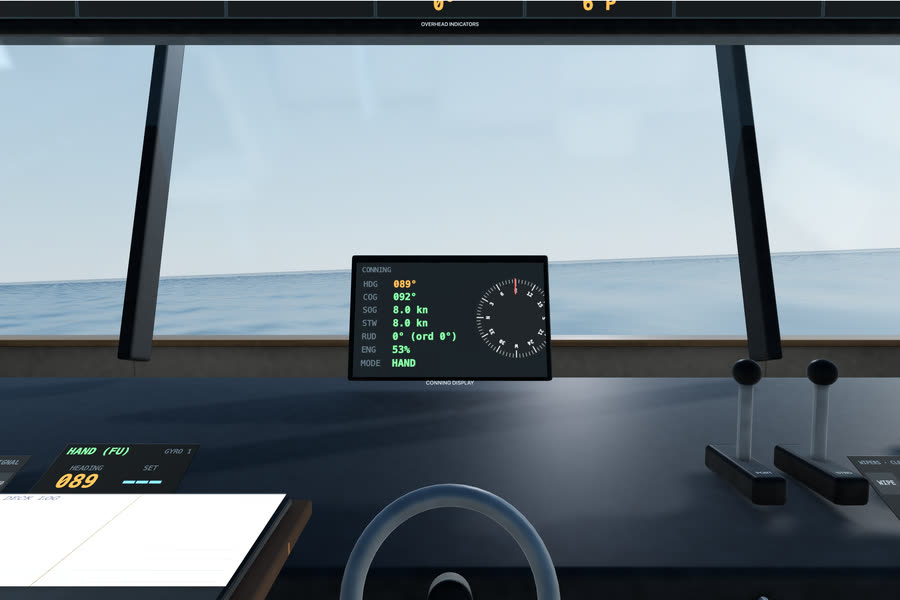
Steering gear test before departure
Test each pump, each control system, local control and the alarms, then leave it ready for sea.
When must the steering gear be tested, and what goes in the test?Often asked
A good answer covers:
- Each pump alone, and both together where they can run together
- Full movement both ways, hard over to hard over, and the time taken
- Each remote control system, and the emergency or local control
- The rudder angle indicator agrees with the actual rudder angle
- The power unit failure and control system alarms
- Entered in the deck log
Show me on the bridgeStopped before departure, with the steering test ahead of you.
How often are emergency steering drills held, and what do they practise?Often asked
A good answer covers:
- Direct control from the steering gear compartment
- The communication procedure between the bridge and the steering gear room
- Operating the alternative power supply where fitted
- The date and details entered in the log
What does the rule say about how fast the main steering gear must move the rudder?
A good answer covers:
- From 35 degrees one side to 30 degrees the other
- In no more than 28 seconds
- At the deepest seagoing draught and full ahead service speed
- Auxiliary gear: 15 degrees one side to 15 the other in not more than 60 seconds, at the deepest seagoing draught and at half speed or 7 knots, whichever is greater
The test is done. How do you leave the steering for sea?
A good answer covers:
- Both pumps running where the rules or the master require it in pilotage and confined waters
- Bridge control on the normal control system
- Hand steering until clear, autopilot only in open water
- Rudder midships and the indicator checked
- The test and its result in the deck log
Show me on the bridgeLook at the steering panel and say how you would leave it.
Emergency steering drill
Bridge steering fails at sea: answer the alarm, start the second pump, steer from the steering gear room, then hand back.
You are on watch and the steering fails. Talk me through your actions.Often asked
A good answer covers:
- Acknowledge the alarm and check what has failed: rudder against the order, pumps, control system
- Call the master, and the engineer to the steering gear room
- Start the second pump and try the other control system and the NFU tiller
- If the bridge cannot steer, take local control in the steering gear room with the bridge giving orders
- Use the engines and thrusters to hold the heading or take the way off if there is danger close
- Show not under command lights or shapes if she cannot manoeuvre, and warn traffic and the VTS
- Log it all, and report it as the master directs
Show me on the bridgeAt sea on the autopilot. The steering will fail soon after you start.
How often are emergency steering drills held, and what must they include?Often asked
A good answer covers:
- Direct control from the steering gear compartment
- The communication procedure between the bridge and the steering gear room
- Operating the alternative power supply where one is fitted
- The date and details recorded in the log
How do you steer the ship from the steering gear room, and how do you talk to the bridge?
A good answer covers:
- The gear is moved directly from the local control, with a rudder angle indicator and a gyro repeater there
- Every order is repeated back and reported when done
- Simple instructions with a block diagram of the changeover are posted on the bridge and in the steering gear room
- Small corrections and steady orders: the person there cannot see where the ship is going
Show me on the bridgeOpen the steering gear panel and find the local control, the rudder angle and the gyro readout.
The steering cannot be fixed quickly and the ship cannot keep out of the way. What does she show?
A good answer covers:
- Not under command: two all-round red lights in a vertical line, or two balls by day
- Sidelights and sternlight as well only when making way through the water
- In restricted visibility, the sound signal of one prolonged and two short blasts
- Tell nearby ships and the VTS on VHF, and consider an urgency message if she is standing into danger
Anchoring and the anchor watch
Slow approach, stop, gentle sternway, let go and pay out; then the anchor position, the watch circle, and what to do when she drags.
How much cable do you put out, and what makes you put out more?Often asked
A good answer covers:
- More in strong wind, a strong stream, poor holding ground or a long stay
- Enough swinging room for the cable plus the length of the yacht
- The cable should lead well out and the anchor must be dug in before you leave it
Show me on the bridgeTen metres of water at the berth. Work out the cable before you let go.
Describe how you bring the yacht to the anchor berth and let go.Often asked
A good answer covers:
- Approach slowly, ideally heading into the wind or stream, whichever is stronger
- Stop at the berth, then a touch of sternway so the cable lays out clear
- Let go, then pay out under the brake, not all at once
- Brought up when the cable rises and then slackens and she lies quietly to it
- Fix the anchor position and set the anchor watch
What do you check on an anchor watch?Often asked
A good answer covers:
- Position by fixes and bearings at regular intervals, and the ECDIS anchor watch circle
- Weather, tide and sea state, and any forecast change
- Anchor lights or shapes shown and the signals of nearby vessels
- Engines and crew ready if the weather turns
- A proper lookout, and the deck log kept up
Show me on the bridgeOnce brought up, look for the anchor mark and the watch circle.
How do you know she is dragging, and what do you do?Often asked
A good answer covers:
- Position moving out of the swing circle and the anchor watch alarm
- Bearings changing steadily the same way, and the cable jerking or lying slack then taut
- Call the Master at once
- Start the engines and use them to take the weight off the cable
- Pay out more cable, or heave up and re-anchor, and warn nearby vessels
Show me on the bridgeA squall is coming. Watch the distance from the anchor.
Helm orders to a helmsman
Put a helmsman on a course, give rudder orders, hear them repeated and reported, steady her and bring her back.
How do you give a helm order, and what should the helmsman do?Often asked
A good answer covers:
- Give it clearly in the standard words: the side and the angle, such as starboard ten, or midships, or a course to steer
- The helmsman repeats it back word for word straight away, so you know it was heard correctly
- He reports when the wheel is at the angle ordered, and when she is steady on the course
- You check it on the rudder indicator and the heading, and acknowledge the report
- Courses are given digit by digit, such as two seven zero, so they cannot be misheard
Show me on the bridgeAt the steering stand: the helm orders, and what the helmsman says back.
What is the difference between "midships", "steady" and "steer two seven zero"?Often asked
A good answer covers:
- Midships puts the rudder amidships; she keeps swinging for a while
- Steady means check her swing and hold the heading she has when the order is given; he reports the heading
- Steer two seven zero is a course to steer: he brings her to it and holds it, and reports when on course
- Hard a port or hard a starboard is full rudder, kept for when it is needed
When would you put a helmsman on the wheel instead of the autopilot?
A good answer covers:
- In confined or busy water, in narrow channels and harbour approaches, and when manoeuvring
- In restricted visibility or heavy traffic, so the officer is free to keep the look-out and the radar
- When the Master or the SMS requires it, and when the autopilot cannot hold her in the weather
- Change over in good time, with the helmsman told the course and the gyro and rudder indicator checked
A strong wind is on the beam. What does it do to her, and how does the helmsman steer?
A good answer covers:
- She makes leeway: her track over the ground is downwind of her heading
- Most ships tend to turn into or away from the wind depending on where the windage is, so the helmsman carries a little rudder to hold the heading
- Steering a course holds the heading, not the track: the officer allows for leeway and set in the course given
- At low speed the wind has more effect, so keep enough speed for steerage
Squat and under keel clearance
Run over shallow water at speed, see the clearance under the keel shrink, and slow her down to get it back.
What is squat, and why does it happen?Often asked
A good answer covers:
- The ship sits lower in the water when she moves through shallow water, so the under keel clearance gets less
- Water speeds up as it flows past and under the hull, and the pressure there falls, so she is drawn down
- It grows with the square of the speed: double the speed and the squat is about four times as much
- It is worst where the depth is less than about twice the draught, and worse still in a narrow channel
- A full-bodied ship (high block coefficient) squats more, and usually by the bow; a fine-lined one less, often by the stern
Show me on the bridgeOpen the echo sounder and watch the depth under the keel at 12 knots, then slow down.
How would you estimate squat, and what do you do about it?Often asked
A good answer covers:
- A rule of thumb: block coefficient times speed in knots squared, divided by one hundred, in metres, for open water; about double that in a confined channel
- Use the ship's own squat figures or tables when she has them
- Allow for it in the under keel clearance in the passage plan, with the tide
- Reduce speed in shallow water: it is the one thing that cuts squat quickly
What are the signs that a ship is in shallow water and squatting?
A good answer covers:
- The echo sounder shows less water under the keel than the chart and the tide would give
- She loses speed for the same engine power, and vibration may increase
- She becomes sluggish to steer and her turning circle grows
- The wave pattern changes: a bigger wash and stern wave
Interaction: a big ship overtaking in a channel
A container ship overtakes close in the Ambrose Channel. Open the gap before she draws level, let her pass and come back to the channel course.
What is interaction between two ships, and when is it worst?Often asked
A good answer covers:
- Water speeds up in the gap between two hulls passing close, the pressure falls, and they are drawn towards each other
- The pressure fields at bow and stern turn the ships too: a bow can be pushed away, then a stern drawn in, so she sheers
- It grows with speed and falls off fast with the gap
- It is worst in shallow water and narrow channels, and when a big ship passes a small one
- Overtaking is the worst case, because the ships stay close for a long time
Show me on the bridgeThe container ship coming up from astern on a line just to port of yours.
A big ship is overtaking you close in a channel. What do you do?Often asked
A good answer covers:
- Agree the overtaking by VHF, as the rules for narrow channels require, and agree which side
- Open the gap as far as the channel safely allows, towards your own side
- Keep a steady speed, or ease it a little to let her pass quickly; do not speed up alongside her
- Use hand steering with a good helmsman and be ready for a sheer: counter it early with the helm
- Watch the depth on your side of the channel, and look out for bank effect
What is bank effect?
A good answer covers:
- Close to a bank or the edge of a channel, the water between the hull and the bank speeds up and the stern is drawn towards the bank
- The bow is pushed away from the bank, so she sheers across the channel
- It grows with speed and with how close and how steep the bank is
- Keep speed moderate, and carry a little helm towards the bank to hold her straight
Berthing from the wing
Take control at the port wing, come in slowly, land softly on the fenders and lie alongside the pontoon.
You are coming alongside a berth. What do you think about before you start the approach?Often asked
A good answer covers:
- Wind and current: their strength and direction against the berth, and which way they will set her
- Which side to, the line of approach and the speed at each stage, and an abort plan
- Where to con from: the wing on the berth side, so you can see the gap and the fenders
- Engines, thrusters and steering tested, and both steering pumps running
- The deck crew briefed: fenders, lines, the order they go out, and how they will talk to you
Show me on the bridgeFrom the port wing: the pontoon ahead to port, and your line of approach.
Why come in so slowly, and how do you judge your speed and the gap?Often asked
A good answer covers:
- The energy in a contact grows with the square of the speed, so a small speed makes a big difference
- Take the way off early: a twin screw yacht stops with astern power, but it takes time and distance
- Close the last few metres sideways, as near parallel as you can, so the whole fendered side lands together
How do you use the thrusters and twin screws to put her alongside?
A good answer covers:
- Bow and stern thrusters together walk her sideways; opposite ways turn her on the spot
- Twin screws: one ahead and one astern turn her with little headway
- The joystick blends engines and thrusters for the movement you ask for
- Know what each control does at the wing before you need it
Show me on the bridgeOpen the port wing docking console and find the joystick, the levers and the thrusters.
There is a fresh wind blowing her off the berth. How does that change your approach?
A good answer covers:
- A yacht has high topsides and little draught, so the wind has a big effect, especially at slow speed
- Approach at a steeper angle, or closer upwind, and allow for her being set off
- Get the first line on and use it, the thrusters or the engines to hold her in
- If the wind is too strong for the thrusters, wait or use another berth: say so to the Master early
Embarking a pilot
Call the pilot station, make a lee at the speed asked for, rig the ladder on the right side at the right height, and hold her until the pilot is aboard.
What are the requirements for rigging a pilot ladder?Often asked
A good answer covers:
- A ladder that is certified, in good condition, and secured to strong points on deck, not to the rails
- Rigged clear of discharges and of the ship's flare, on the side and at the height the pilot asked for
- A lifebuoy with a self-igniting light and a heaving line at hand, and the boarding point lit at night
- Rigged and checked by a responsible officer, who is at the boarding point in touch with the bridge while the pilot boards
Show me on the bridgeAt the port wing console: the pilot boarding section, the ladder and its fittings.
How do you handle the ship for a pilot boarding?Often asked
A good answer covers:
- Call the pilot station in good time and agree the boarding side, the height of the ladder, the course and the speed
- Make a lee on the boarding side: wind and sea on the other side
- Keep a steady course and the speed asked for, usually a few knots, enough to steer but no more
- Keep a look-out for the pilot boat and avoid wheel or engine movements while she is alongside
- Tell the pilot station when the pilot is on board, and log the time
When would a pilot refuse to board, and what do you do?
A good answer covers:
- A ladder that is unsafe, wrongly rigged, at the wrong height, or on the wrong side
- No lee, too much speed, or the ship swinging
- Missing fittings: no lifebuoy, heaving line, lighting or officer
- Put it right straight away, tell the pilot station, and keep the ship clear of danger while you wait
See the lessons and a clip on the Ship handling page. Preparing for the OOW 3000 oral? See the syllabus, topic by topic.