Watchkeeping and bridge routine: oral questions and answers.
27 questions from 7 lessons, with what a good answer covers. Most-asked first within each lesson.
Reading the answers is free. "Show me on the bridge" opens that moment in the simulator, with a pass.
The bridge controls: steering, engines, whistle, VHF, alerts, deck log and VDR
Use the controls every later lesson relies on: hand steering and autopilot, the telegraph, the whistle, the VHF, the central alert panel, the deck log and the VDR.
How do you change over from autopilot to hand steering, and when would you?Often asked
A good answer covers:
- In traffic, in restricted visibility, in narrow waters, or whenever the master orders, and with time to spare
- Have the helmsman at the wheel first, then select hand steering and give a course to steer
- Check the helmsman is steering well and the rudder indicator follows the wheel
- Changing back: line up on the course, set the autopilot heading, then select autopilot and watch it hold
- Test the hand steering after a long spell on the autopilot, and before entering waters that need special caution (SOLAS V/24)
Show me on the bridgeThe helm station: the wheel, the NFU tiller and the steering mode selector.
What are the priorities of bridge alerts, and what is the difference between silencing and acknowledging?Often asked
A good answer covers:
- Emergency alarm, alarm, warning and caution, in falling order of urgency
- An alarm needs immediate attention and action; a warning needs attention, and becomes an alarm if left; a caution is for awareness only
- Silencing stops the sound for a short time but leaves the alert active and unacknowledged
- Acknowledging means you have seen it and taken responsibility; it should be done where the problem can be dealt with
What does the VDR record, and what do you do with it after an incident?
A good answer covers:
- Position, speed, heading, bridge audio, VHF, radar and ECDIS pictures, alarms, echo sounder, engine and rudder orders and responses, among others
- It keeps a rolling record, so after an incident press Save at once so the record is not overwritten
- Tell the master, and do not switch it off or tamper with it
- It is checked by an annual performance test
What goes in the deck log, and why does it matter?
A good answer covers:
- Courses, speeds and positions, the weather, alterations and the reasons for them, and anything unusual
- Equipment failures and tests, drills, and calls to the master
- It is a legal record: written at the time, in ink, never erased, mistakes struck through and initialled
- It may be evidence after an incident, so enter facts, not opinions
BNWAS test
Test every stage, every reset device and the emergency call, find the faulty reset, and leave the BNWAS as the master set it.
What is a BNWAS for, and how does it work when nobody resets it?Often asked
A good answer covers:
- It checks the officer of the watch is awake and on the bridge, and calls help if not
- After the dormant period, set between 3 and 12 minutes, a visual indication on the bridge
- Then an audible alarm on the bridge, 15 seconds after the visual one
- Then, 15 seconds later, the alarm at the master and the back-up officer, and 90 seconds after that (up to 3 minutes on larger ships) at other crew locations
- The emergency call sends it straight to the master and back-up officer
Show me on the bridgeOpen the BNWAS panel: mode, dormant timer, stage lamps and the reset.
What are the operating modes, and who may change them?Often asked
A good answer covers:
- Automatic: running whenever the autopilot or track control is engaged
- Manual on: always running
- Manual off: not running
- Mode and dormant period are protected by the master's key or a password, so the watch cannot change them
Where can it be reset, and what counts as a reset?
A good answer covers:
- Only at bridge positions where the officer can keep a proper lookout
- One deliberate action by the officer resets it and starts a full dormant period
- A button held or stuck in must not keep resetting it
- Some sets also accept a reset from other bridge equipment or a movement sensor; flag and class views differ, so follow the yacht's approved set-up
- Every reset device is tried in a test, and a faulty one reported and logged
Show me on the bridgeThe starboard wing. Try its reset and see whether the dormant timer starts again.
How would you test the BNWAS, and how do you leave it?
A good answer covers:
- With the master's permission and the key, set manual on and a short dormant period
- Let each stage run and reset at the right moment, warning the master and crew before their alarms sound
- Try every reset device and the emergency call
- Put the mode and dormant period back exactly as the master set them, and take the key out
- Log the test, and report any defect
Reporting to the VTS inbound
Find the reporting points and the channel in the pilot book and radio list, and report at each point from inside its circle.
What is a VTS, and what can it do for you?Often asked
A good answer covers:
- A shore service that watches and manages traffic in a port or busy area, set up by the coastal state
- An information service: traffic, hazards, weather and the state of the fairway, given at set times or when asked
- Navigational assistance, where it is offered, to help a ship that asks for it or needs it
- Traffic organisation: planning movements to prevent dangerous situations
- The master stays responsible for the ship, and the rules of the road still apply
Where do you find a VTS's reporting points and channels, and when do you look?Often asked
A good answer covers:
- At the passage planning stage, so the points are on the chart and in the plan before you arrive
- The pilot book, or sailing directions, for the points and what each report must contain
- The radio list for the VTS name, its channels and hours
- Chart notes and the port guide, and the latest notices to mariners for any changes
- Check the channel against the latest correction: channels do change
Show me on the bridgeChart table, Pilot and radio list. Find the reporting points and the VTS channel.
How do you make a report to a VTS, and what goes in it?
A good answer covers:
- Listen on the channel first, so you do not talk over another ship
- Call the VTS by its name, then give your ship's name, and call sign if asked
- Your position as the reporting point, plus whatever the pilot book asks: destination, ETA, draught, defects
- Short and clear, in standard marine phrases
- Then keep a listening watch on the VTS channel until you leave the area
The VTS tells you something you think is unsafe. What do you do?
A good answer covers:
- The master and the officer of the watch stay responsible for the safe navigation of the ship
- Do not follow advice blindly: question it on the VTS channel and say what you intend to do
- The collision regulations still apply to every encounter
- Call the master, and log what was said and done
Taking over the night watch
Read and sign the orders, work the taking-over checklist honestly, then call the master and work the fog checklist when visibility drops.
What do you satisfy yourself of before you take over a navigational watch?Often asked
A good answer covers:
- The master's standing orders and any night orders or special instructions, read and signed
- Position, course, speed and draught, and the next part of the passage plan
- Tides, currents, weather and visibility, and how they will affect the ship
- Traffic about, what is being tracked, and any vessel of concern
- The state of the navigation equipment: steering mode, engines, compass errors, alarms, and any defects
- Navigation lights right for what the ship is doing
- Your eyes adjusted to the light before you accept the watch
Show me on the bridgeThe chart table: the orders and the taking-over checklist are under Orders and checklists.
When should a watch not be handed over?Often asked
A good answer covers:
- Not while a manoeuvre or avoiding action is under way: finish it first
- Not until the relieving officer is fully able to take over, rested, fit and with their eyes adjusted
- If the relieving officer is not fit for duty, do not hand over and tell the master
- Until the handover is complete, the officer going off watch stays responsible
Visibility closes in during your watch. What do you do?Often asked
A good answer covers:
- Call the master, as the night orders say and as STCW expects
- Sound the fog signal for a power-driven vessel making way
- Both radars running and plotting, with targets acquired
- Navigation lights on, and an extra lookout posted, listening as well as watching
- A safe speed, with the engines ready for immediate manoeuvre, and hand steering considered
- Time and position entered in the log
Show me on the bridgeFog comes in after about ten minutes. Look out of the windows, then at the radars.
What's the difference between the standing orders and the night orders?
A good answer covers:
- Standing orders are the master's lasting instructions for every watchkeeper on board
- Night orders are the master's instructions for one particular night, written for that passage
- Night orders add to the standing orders; they do not cancel them
- Each officer reads and signs both before taking the watch
- They often set figures, such as the visibility at which to call the master
Bridge team challenges: speaking up to the pilot
The pilot orders a course that takes her out of the channel. Check it, speak up, and escalate until it is put right.
With a pilot on board, who is responsible for the ship, and what does the officer of the watch do?Often asked
A good answer covers:
- The pilot advises and cons, but the Master stays responsible for the ship, and the officer of the watch keeps the watch
- Exchange information with the pilot: the plan, the ship's handling, and anything unusual
- Monitor every order: check it against the plan, the chart and the ship's position and movement
- If in doubt about the pilot's actions, ask him; if still in doubt, tell the Master and act if the ship is in danger
- Keep the look-out, the radar and the ECDIS going, and the pilot informed
Show me on the bridgeAt the steering stand: the pilot's orders, and the ways to speak up about one.
You think the person conning has made a mistake. How do you raise it?Often asked
A good answer covers:
- Start with a question, so the mistake can be put right easily, or the reason explained
- If that does not settle it, state the concern plainly, with the facts: the course, the danger, the time
- If it still is not put right, challenge: say what is wrong and what you recommend
- If the ship is standing into danger and there is no time, act: take the con or call the Master, and say so
- Use names and clear words, and make sure you were heard
Why do junior officers sometimes fail to speak up, and how does a good bridge team prevent it?
A good answer covers:
- Rank and experience: reluctance to question the Master or the pilot
- Not being sure, or not wanting to look wrong
- A good team briefs the plan, invites challenge, and agrees how concerns are raised
- Closed-loop communication: orders repeated back and confirmed
Night watch: night vision, both radars, ECDIS take-over
Set the bridge up for the night, keep both radars running, take over on the back-up ECDIS when the main one fails, and keep clear.
How do you keep your night vision on watch, and why does it matter?Often asked
A good answer covers:
- One burst of white light undoes it, so red lighting only in the wheelhouse
- Every screen dimmed to the lowest level you can still read, and the ECDIS on its night palette
- Chart table curtain drawn whenever its lamp is on
- The relieving officer does not take over until their eyes have adjusted
- A lookout who cannot see in the dark is no lookout at all
Show me on the bridgeThe wheelhouse as the day watch left it. Look at the lighting and the screens.
When must the officer of the watch call the master?Often asked
A good answer covers:
- Restricted visibility met or expected
- Traffic, or the movement of another vessel, causing concern
- Difficulty keeping to the course, or land or a mark not sighted when expected, or an unexpected change in depth
- Failure of the engines, steering, or any essential navigational equipment, alarm or indicator
- Radio equipment failure, heavy weather causing concern, or any hazard such as ice or a derelict
- Any other emergency, or whenever in any doubt; the standing and night orders may add more
The main ECDIS fails at night in a busy approach. Talk me through what you do.Often asked
A good answer covers:
- Acknowledge the malfunction alarm and note the time and position
- Take over on the back-up ECDIS straight away and check the route, chart and safety settings on it match
- Check the position on it against radar ranges and visual bearings
- Keep the lookout and the radar plotting going throughout; the traffic does not wait
- Tell the master, log it, and report the defect
- Be ready to go to the paper charts if the back-up fails too
What lights does this yacht show under way at night, and why two masthead lights?
A good answer covers:
- A masthead light forward and a second, higher one abaft it
- The second masthead light is required because she is 50 metres or more in length
- Sidelights, and a sternlight
- No anchor lights: all-round white lights would tell other ships she is at anchor
You come up to take the night watch. What is wrong with this picture?
A good answer covers:
- The anchor lights are still on with the steaming lights
- The wheelhouse lighting is white and bright, so nobody keeps night vision
- The ECDIS is still on its day palette
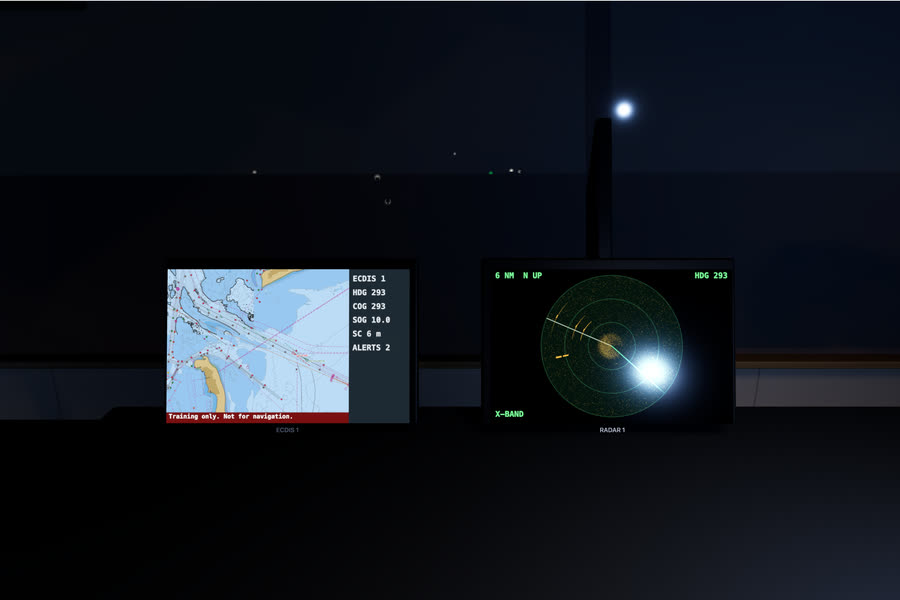
- Radar 2 is on stand-by, so only one radar is running in traffic
Show me on the bridgeLook at the lights, the lighting, the ECDIS and both radars.
Preparing for the pilot and the master-pilot exchange
Make the bridge ready for the pilot, fill in the pilot card, then hand it over, check his plan against ours and agree the con.
How do you prepare the bridge for taking a pilot?Often asked
A good answer covers:
- The passage plan covers the pilotage to the berth, and the pilot station has our ETA
- Steering gear tested, engines on stand-by and on bridge control, thrusters ready
- Anchors cleared away and ready to let go, with the crew standing by
- The pilot card filled in, and the wheelhouse poster and manoeuvring data at hand
- The Master called, and the boarding arranged: side, ladder height, lee and speed as the pilot station asks
Show me on the bridgeAt the port wing console: the checks before the pilot, and the pilot card.
What goes on the pilot card?Often asked
A good answer covers:
- The ship: name, call sign, length, beam and tonnage
- Draughts forward and aft, and the air draught, as they are now
- Engines and propellers: type, power, and the speeds at each engine order; thrusters
- Anchors and cable, and anything else in the manoeuvring data
- Defects that matter to the pilot: engines, steering, thrusters, navigation equipment
What is covered in the master-pilot exchange?Often asked
A good answer covers:
- The ship to the pilot: the pilot card, the wheelhouse poster, how she handles, and any defects
- The pilot's plan: route, speeds, tugs, berthing, and the tide, weather and traffic he expects
- His plan checked against our passage plan, differences talked through and agreed before going on
- Who has the con, the Master still responsible, and how the officer of the watch monitors and speaks up
- The working language, the VTS and VHF channels, and how orders to the helm are given and repeated
See the lessons and a clip on the Watchkeeping page. Preparing for the OOW 3000 oral? See the syllabus, topic by topic.