Radar and ARPA: oral questions and answers.
46 questions from 10 lessons, with what a good answer covers. Most-asked first within each lesson.
Reading the answers is free. "Show me on the bridge" opens that moment in the simulator, with a pass.
Radar: setting up from cold
Both radars from cold: scanner check, gain, tune, clutter, monitor, heading line and display modes.
Set the radar up from cold for navigation and collision avoidance. Talk me through it.Often asked
A good answer covers:
- Check the scanner area is clear of people and obstructions before transmitting
- Switch on, let it warm up to standby, choose a sensible range before transmitting
- Brilliance and palette for the light, then gain, then tune, then rain and sea clutter
- Gain until speckle just shows, then back off until it has just gone
- Least sea and rain clutter that clears the picture, without losing small targets
- Check the performance monitor and the heading line
- North-up, relative motion, sea-stabilised for collision avoidance; speed from the log
Show me on the bridgeBoth sets are cold and left as the night watch had them.
What does a SART look like on the radar, and what would you do? And a racon?Often asked
A good answer covers:
- A SART answers only an X-band (9 GHz) radar
- At range it shows as a line of 12 dots outward along its bearing; the nearest dot can be up to about 0.6 miles beyond the SART, and within about 150 metres when close
- As you close to about a mile the dots become arcs, then circles round the centre very close in
- Treat it as distress: tell the master, report to the rescue coordination centre, and go to assist
- A racon paints a Morse identity letter outward from behind the beacon, so it can be identified on the chart
Show me on the bridgeA SART is transmitting about 7 nm ahead. Look on the 12 mile range.
Sea-stabilised or ground-stabilised: which would you use, when, and why?
A good answer covers:
- Sea-stabilised uses speed through the water from the log; ground-stabilised uses speed over the ground from GNSS
- Use sea-stabilised for collision avoidance: target headings and aspect match what you see from the bridge
- In a stream, ground-stabilised shows a target's course over the ground, which can give the wrong aspect and the wrong action
- Use ground-stabilised for navigation, such as true trails of land and buoys, and anchor watch
Show me on the bridgeA vessel lies stopped in the water ahead in a 2 kn stream. Compare the two modes on her vector.
X-band and S-band radar: what is the difference and when would you rely on each?
A good answer covers:
- X-band is about 3 cm (9 GHz); S-band about 10 cm (3 GHz)
- X-band gives better bearing and range discrimination and sees small targets better
- S-band is less affected by rain and sea clutter and gives better long range detection in bad weather
- Only X-band triggers a SART; racons usually answer both
Show me on the bridgeBoth sets are running. Compare the shower to the south-west on radar 1 and radar 2.
What false echoes do you know, and how would you recognise each one?
A good answer covers:
- Side lobe echoes: an arc or a row of echoes at the same range as a strong close target
- Multiple echoes: evenly spaced echoes on the same bearing beyond a large close target, often abeam
- Indirect echoes: reflected off own ship's structure, appearing on the bearing of the obstruction at the true range
- Second-trace echoes: a distant target returning after the next pulse, shown at the wrong range; they move when the range scale or pulse rate is changed
- Check doubtful echoes by changing range or pulse, and against the chart and the visual picture
Why might you not see a small boat close in on the radar?
A good answer covers:
- Too much sea clutter suppression wipes out small echoes close in
- The boat may be in a blind or shadow sector
- Inside the minimum range of the set
- A small, low, wooden or GRP boat gives a weak echo, lost among waves or rain
- Gain set too low
- So keep a proper visual lookout as well (COLREG Rule 5)
Show me on the bridgeThere is a fishing boat about a mile off. Can you find her?
What are blind and shadow sectors, and what do you do about them?
A good answer covers:
- Blind sectors are arcs where the scanner sees nothing, behind masts, funnels and other structure
- Shadow sectors are arcs where detection is reduced but not lost
- They are found by a survey and recorded on a diagram on the bridge
- Keep a lookout over those arcs by other means, and alter course now and then to look into them
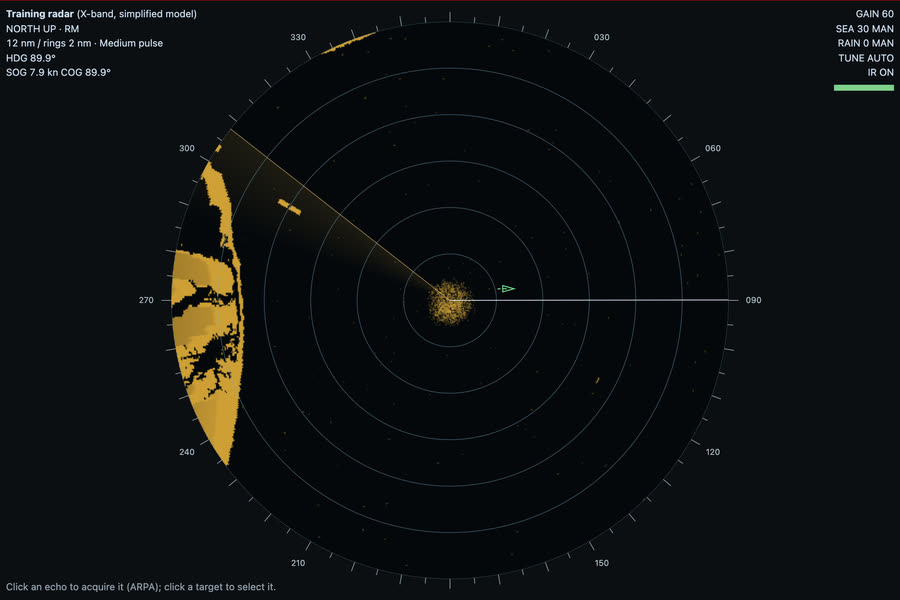
Show me on the bridgeLook for the dark arcs in the sea clutter astern.
What's wrong with this radar picture?
A good answer covers:
- Head-up in traffic
- Gain too high
- Sea clutter too high
- Range too short for the situation
Show me on the bridgeFind every fault on radar 1, then say why each matters.
How long does a radar take to be usable from cold, and what is stand-by for?
A good answer covers:
- From stand-by it transmits again within seconds
- Stand-by keeps it warm and ready without transmitting, for example alongside or with people near the scanner
What does the performance monitor tell you, and how often would you check it?
A good answer covers:
- It checks the transmitter and receiver together and shows a reference pattern on the screen
- Compare it with the pattern recorded when the set was known to be good; a smaller pattern means lost performance
- Check it when taking over the watch, regularly during it, and whenever detection seems poor
- Report a fall in performance and record it
How would you check the heading line alignment?
A good answer covers:
- Pick a small, conspicuous object near right ahead
- Take a visual bearing and a radar bearing with the EBL at the same moment, or put the ship's head on it
- If not, every radar bearing is wrong: report it and have it adjusted
Show me on the bridgeCompare the heading line with a mark right ahead.
Radar: target discrimination
Two pairs of yachts: see them merge on the long pulse and the wider S-band beam, and separate on the short pulse and the X-band.
What is bearing discrimination, and what decides it?Often asked
A good answer covers:
- The ability to show two targets at the same range, close together in bearing, as two separate echoes
- Decided mainly by the horizontal beamwidth: two targets closer in bearing than about one beamwidth merge
- A longer aerial gives a narrower beam; X-band gives a narrower beam than S-band for the same aerial length
- Each echo is smeared by the beamwidth, so at long range two ships or a ship and a buoy can paint as one
Show me on the bridgeTwo yachts side by side on 041°: compare the S-band with the X-band.
What is range discrimination, and how can you improve it?Often asked
A good answer covers:
- The ability to show two targets on the same bearing, close together in range, as two separate echoes
- Decided by the pulse length: two targets closer than about half the pulse length in range merge (150 m for a one microsecond pulse)
- A shorter pulse improves it, which is why the short pulse goes with the short ranges
Show me on the bridgeTwo yachts one behind the other on 120°: long pulse, then short.
What limits the radar's minimum range, and why does it matter on a yacht?
A good answer covers:
- Minimum range is the closest a target can be detected: limited by the pulse length, the time the receiver needs to recover, and the vertical beamwidth
- The vertical beam passes over close, low targets, more so with a high aerial
- Sea clutter close in hides small targets too
- So a small boat close in may not show at all: keep the look-out, use the short pulse and the short range close in
How do target size and aspect affect what the radar shows?
A good answer covers:
- Echo strength depends on size, material, shape and aspect, not only size: a big ship end-on can paint weaker than beam-on
- Wood, GRP and rounded shapes reflect poorly; flat steel faces square to the beam reflect well
- A low target is detected later than a high one of the same size, because of the radar horizon
- So the size of an echo is not a reliable guide to the size of the vessel
Radar blind and shadow sectors: find them and record them
Survey both radars in the sea clutter, measure each sector with the EBL, record it, and report the survey.
What is the difference between a blind sector and a shadow sector, and what causes them?Often asked
A good answer covers:
- Blind sector: an arc where the beam is blocked and nothing is detected
- Shadow sector: an arc where the beam is partly blocked and detection is reduced, so weak targets are lost
- Caused by masts, funnels, other aerials, cranes and structure near the scanner
- The nearer and wider the obstruction, the wider and deeper the sector
Show me on the bridgeLook astern in the sea clutter for the darker wedges.
How would you find a radar's blind and shadow sectors?Often asked
A good answer covers:
- In moderate sea clutter, look for dark or thinned wedges where the clutter should be
- Set the sea clutter so it only just speckles: too much or too little hides a shallow shadow
- Measure the edges as relative bearings with the EBL
- Or swing the ship slowly past a small isolated echo, such as a buoy, and note where it fades and returns
- Record them on a diagram by the display, and repeat the survey after any change near the scanner
You know your radar is blind astern. What does that mean for your watch?
A good answer covers:
- A vessel overtaking from astern may not show until she is close
- Keep a visual lookout over the blind arcs, and use the other radar if it covers them
- Alter course now and then to look into the blind sector
- AIS can help, but not every vessel carries it
Radar: a SART and a racon
Find a liferaft's SART and a charted racon, take their bearing and range, and report.
How does a SART show on the radar, and how does it change as you close it?Often asked
A good answer covers:
- Only on the X-band, 3 centimetre radar; the S-band does not trigger it
- A line of about twelve dots running outward along its bearing
- The dot nearest own ship marks the SART, very close to its true position
- As you close to about a mile the dots become arcs, and very close they become circles
- Reduce sea clutter and adjust gain carefully so it is not suppressed, and use a range of 6 to 12 miles to see it
Show me on the bridgeA SART about seven miles ahead. Find the line of dots and say where the craft is.
At what range would you expect to detect a SART, and what limits it?
A good answer covers:
- At least 5 nautical miles from a ship radar with its antenna 15 metres up and the SART at least a metre above the sea
- Range depends on the height of both the SART and the scanner, so hold it as high as possible
- Sea clutter, rain and heavy seas hiding the craft can all reduce detection
What is an AIS-SART and how will you see it?
A good answer covers:
- A survival craft locating device that sends AIS position reports from its own GNSS
- Shows on AIS displays, the ECDIS and the radar overlay as a circle with a cross
- Its MMSI starts with 970 and the text says SART active or SART test
- It gives a position, not just a bearing, and does not depend on radar band
Show me on the bridgeTurn on the AIS overlay and find the AIS-SART beside the radar SART.
What is a racon, and how do you identify one?
A good answer covers:
- A radar beacon on a mark that answers the radar pulse
- Shows as a Morse letter painted outward from just beyond the mark
- The letter is printed on the chart beside the mark, so it identifies the mark
- Many answer on X-band only; check the chart and the list of radio signals
- It can hide a small target behind it, and rain or sea clutter controls, or a mistuned set, can weaken or hide it
Parallel indexing on the radar
Set a PI line on the coast, spot the set towards the land on the radar, regain the track and allow for it.
What is parallel indexing, and why use it?Often asked
A good answer covers:
- A line on the radar parallel to the planned track, offset by the planned passing distance of a radar conspicuous mark
- If the mark's echo runs along the line, the ship is on track; if it moves off, she is being set
- It shows cross-track error at a glance, continuously, without plotting fixes
- It is independent of GNSS: a check on the ECDIS position, and a back-up if GNSS fails or is spoofed
Show me on the bridgeThe coast is about two and a half miles to starboard. Where would you put the PI line?
How do you plan and set up PI lines for a passage?Often asked
A good answer covers:
- At the planning stage, pick a mark that paints well and is charted accurately: a headland, a light structure, a racon
- Measure the beam distance from the track to the mark on the chart, and mark it on the plan
- On the radar, set the line's bearing to the track course and its offset to that distance, on the right side
- Use a north-up, true or relative motion, stabilised display; check the gyro error, since it turns the lines
- Add wheel-over and abort lines, and limiting lines for the safe water each side
What are the limitations and traps of parallel indexing?
A good answer covers:
- Indexing off the wrong echo, especially on a featureless or low coast
- Gyro error or a wrong heading input shifts every line
- Lines set relative to the heading are wrong after an alteration unless they are reset
- It shows where you are against one mark only: still cross-check by other means
Radar plotting: the relative motion triangle
Plot a crossing ship by hand from three observations, find her CPA, course, speed and aspect, and the effect of our alteration.
Draw me the relative motion triangle and tell me what each side means.Often asked
A good answer covers:
- O is the first plotted position of the target, A the position after the plotting interval
- OA is her relative motion; run it on past A and its closest pass of own ship is the CPA
- WO is own ship course and speed over the interval, laid off back from O
- WA is her true course and speed over the same interval
- The interval must be the same for every side, and own course and speed steady during it
Show me on the bridgeThe coaster on the starboard bow. Take your first observation off EBL 1 and VRM 1.
How many observations do you want before you decide anything from a plot, and why?Often asked
A good answer covers:
- At least three where there is time, a few minutes apart
- They show whether she is steady on her course and speed: plots in a straight line, evenly spaced
- One observation tells you nothing about her motion, and two cannot show that she is changing
- Assumptions on scanty information, especially scanty radar information, are what the rules warn against
On the plot, how do you work out what an alteration of course or a reduction of speed will do?Often asked
A good answer covers:
- Keep W and A where they are: her true motion does not change because we alter
- Lay off our new course and speed from W to give O prime
- Her new relative motion runs from A parallel to O prime A; its closest pass is the new CPA
- Slowing down shortens WO, so O prime moves towards W; altering swings O prime round W
What is aspect, and what does red thirty tell you?
A good answer covers:
- Aspect is our bearing from the other ship, measured from her heading, red or green
- Red thirty: we are thirty degrees on her port bow
- So she will be showing us her red sidelight at night, and her masthead lights a little open
- It tells us how she sees us, which helps work out which rule applies
What can make a radar plot wrong?
A good answer covers:
- Wrong own course or speed on the plot, which spoils her true course and speed but not the CPA
- Poor bearings or ranges, and too short a plotting interval
- Own ship or the target altering during the plot
- Through the water against over the ground: in a tide the true vector and aspect can mislead
ARPA: acquire, assess and act
Acquire a crossing ship, read the CPA, alter boldly to starboard and check the action works.
You acquire a target on ARPA. How long before you can trust what it tells you?Often asked
A good answer covers:
- A trend of its motion within about one minute
- Full accuracy of the predicted motion within about three minutes
- Longer after either ship alters, while the tracker settles again
- Keep watching the bearing and range yourself meanwhile
Show me on the bridgeAcquire the coaster on the starboard bow and watch the track settle.
When would you use true vectors, and when relative?Often asked
A good answer covers:
- Relative vectors show the risk: a vector pointing at own ship means a steady bearing and collision course
- True vectors show what the other ship is really doing: her course and speed, and so her aspect and the rule that applies
- Use both: relative to detect risk, true to decide the action
- In sea stabilisation true vectors match her heading; ground stabilisation can mislead in a strong tide
How do you decide whether risk of collision exists?Often asked
A good answer covers:
- Use all available means: radar, ARPA, AIS, visual bearings and the look-out
- A compass bearing that does not change appreciably means risk exists
- Risk can still exist with a changing bearing, for a large ship or at close range
- Do not decide on scanty information, such as one radar observation or AIS alone
- Systematic observation: plotting or ARPA, over time
A ship is crossing from starboard on a steady bearing. What do you do, and how do you check it worked?Often asked
A good answer covers:
- We are the give-way vessel: take early and substantial action to keep well clear
- Usually a bold alteration to starboard, large enough to be obvious on her radar and to her eyes
- Avoid crossing ahead of her
- Check the action is working: the bearing changes, the CPA opens on ARPA, and keep checking until she is past and clear
- Return to course only when she is finally past and clear
Show me on the bridgeThe coaster crossing from starboard: plan your action.
What are the main limitations of ARPA?
A good answer covers:
- It tracks echoes, so a target lost in clutter, rain or a shadow sector is lost to ARPA too
- Target swap when two echoes pass close to each other
- Errors from wrong heading or speed input, and from the wrong stabilisation
- Delay: a target alteration takes time to show
- It does not tell you which rule applies or what the other ship will do
ARPA: automatic acquisition and the acquisition zone
Set an acquisition zone, let ARPA pick up a closing ship by itself, and deal with the warning.
What is an acquisition zone on ARPA, and how would you set one?
A good answer covers:
- An area round the ship, a ring or a sector between two ranges, in which ARPA acquires new echoes by itself
- It warns the officer when it acquires a target, so a ship closing in is not missed
- The inside edge goes clear of the sea clutter round the ship, or clutter is acquired as targets
- The outside edge far enough out to give time to assess and act, matched to the range scale and the traffic
- Set it to the situation and check it at handover; it is an aid, not a substitute for the look-out
Show me on the bridgeSet an acquisition zone between one and three miles and wait for the coaster to cross into it.
What are the limitations of automatic acquisition?
A good answer covers:
- It only takes what paints: a small or weak echo, or one in clutter, rain or a shadow sector, may never be acquired
- Clutter and spurious echoes can be acquired as false targets
- A target that appears already inside the zone, close in, may be acquired late
- In busy water it can fill the tracker's capacity with targets that do not matter
- It does not assess risk: the officer still decides, by systematic observation and a proper look-out
When is an acquisition zone useful, and when would you not rely on it?
A good answer covers:
- Useful in open water with light traffic, especially at night or in restricted visibility, as a second check
- Not to be relied on in heavy clutter, rain or busy water, where it misses or over-acquires
- Never a reason to watch the radar less or to cut the look-out
- Acknowledge each warning and assess the new target straight away
Radar stabilisation: sea or ground, true motion, and a speed log error
See what ground and sea stabilisation do to true vectors in a tide, set true motion, and catch a log reading low.
Sea or ground stabilisation: which do you use for collision avoidance, and which for navigation?Often asked
A good answer covers:
- Sea stabilised (log on water track): true vectors show other ships' course and speed through the water, which matches their heading and so their aspect
- That is what the COLREGs judge by, so use sea stabilisation for collision avoidance, especially in a strong tide
- Ground stabilised (GNSS, or the log on bottom track): true vectors show course and speed over the ground, and land and fixed objects stay still
- Use ground stabilisation for navigation, parallel indexing and the radar overlay on the ECDIS
- Relative vectors and the CPA are the same either way: stabilisation changes only the true vectors and trails
Show me on the bridgeAcquire the ship ahead and switch between GNSS and the log for the speed input.
What happens to the radar picture if the speed or heading input is wrong?Often asked
A good answer covers:
- A log reading low makes stationary objects seem to move ahead; reading high, astern. Stopped ships get false true vectors
- A gyro error turns the whole picture, every bearing, and the true vectors with it
- CPA and TCPA from relative motion are not affected by a speed error, but aspect and true course are
- Check the inputs: log against GNSS and the engine, gyro against the magnetic compass and transits
- A fixed echo with a true trail or vector tells you something is wrong
What is the difference between relative and true motion on the radar?
A good answer covers:
- Relative motion: own ship stays fixed on the screen and other echoes move relative to her; their trails show relative motion, and so the risk
- True motion: own ship moves across the screen and is reset when she nears the edge; echoes move as they really do
- In true motion, land stays still when ground stabilised, so it is good for navigation in pilotage waters
- Trails can be relative or true whatever the motion mode; read which before you judge
What is a reference target, and when would you use one?
A good answer covers:
- A fixed echo tracked by the ARPA, such as a rock, a light structure or an anchored ship, used to give ground stabilisation
- Useful when GNSS is lost or doubted and there is no bottom-track log
- The echo must really be fixed: a buoy may move, and an anchored ship swings
- If the reference is lost or swaps, the stabilisation goes wrong with it
ARPA trial manoeuvre: try it, make it, check it
In fog, plot a crossing ship, find a safe alteration with the ARPA trial, make it, and check it worked.
What does the ARPA trial manoeuvre show you, and what are its limits?Often asked
A good answer covers:
- The predicted CPA and TCPA of every tracked target if we took the trial course and speed
- A delay can be set, to see the effect of acting now or in a few minutes
- It shows TRIAL clearly, so nobody takes the trial picture for the real one
- It assumes the targets hold their course and speed; a set to the current standard models our own turn and speed change and counts down to it, but an older set may not
- It is only as good as the tracks: settled tracks, the right speed input
Show me on the bridgeFog, two targets ahead. Acquire both and try a trial course.
In fog you detect a ship forward of the beam by radar alone. Which alterations does Rule 19 tell you to avoid?Often asked
A good answer covers:
- An alteration to port for a vessel forward of the beam, other than one being overtaken
- An alteration towards a vessel abeam or abaft the beam
- There is no stand-on vessel in restricted visibility: if risk exists, both take avoiding action in ample time
- A ship heard forward of the beam: reduce to the minimum steerageway, and stop if necessary
How big should the alteration be, and why?Often asked
A good answer covers:
- Large enough to be readily apparent to the other ship on her radar
- A succession of small alterations is to be avoided
- Big enough to pass at a safe distance, the CPA the standing orders ask for
- Made in good time, and not leading into another close-quarters situation
You have made the alteration. How do you check it is working?
A good answer covers:
- Trial off first, so the display shows the real picture
- Give the tracks a minute or two to settle after our turn
- Watch the CPA open on ARPA and the bearing change, and keep plotting
- Keep checking until she is finally past and clear before resuming course
Show me on the bridgeAfter the alteration: what would you look at, and for how long?
See the lessons and a clip on the Radar and ARPA page. Preparing for the OOW 3000 oral? See the syllabus, topic by topic.