ARPA: automatic acquisition and the acquisition zone
Set an acquisition zone, let ARPA pick up a closing ship by itself, and deal with the warning.
- Phase 4: Collision avoidance
- 3 steps on the bridge
- 3 oral questions
What you do on the bridge
- Set the zone
- Let the zone take her
- Acknowledge the warning
The oral questions, and what a good answer covers
The key points are in our own words. In the course, these questions come once you have done the job.
What is an acquisition zone on ARPA, and how would you set one?
A good answer covers:
- An area round the ship, a ring or a sector between two ranges, in which ARPA acquires new echoes by itself
- It warns the officer when it acquires a target, so a ship closing in is not missed
- The inside edge goes clear of the sea clutter round the ship, or clutter is acquired as targets
- The outside edge far enough out to give time to assess and act, matched to the range scale and the traffic
- Set it to the situation and check it at handover; it is an aid, not a substitute for the look-out
Show me on the bridgeSet an acquisition zone between one and three miles and wait for the coaster to cross into it.
What are the limitations of automatic acquisition?
A good answer covers:
- It only takes what paints: a small or weak echo, or one in clutter, rain or a shadow sector, may never be acquired
- Clutter and spurious echoes can be acquired as false targets
- A target that appears already inside the zone, close in, may be acquired late
- In busy water it can fill the tracker's capacity with targets that do not matter
- It does not assess risk: the officer still decides, by systematic observation and a proper look-out
When is an acquisition zone useful, and when would you not rely on it?
A good answer covers:
- Useful in open water with light traffic, especially at night or in restricted visibility, as a second check
- Not to be relied on in heavy clutter, rain or busy water, where it misses or over-acquires
- Never a reason to watch the radar less or to cut the look-out
- Acknowledge each warning and assess the new target straight away
How the lesson runs
The tutor's narration from the lesson, step by step. On the bridge, each control lights up as it is named.
Brief
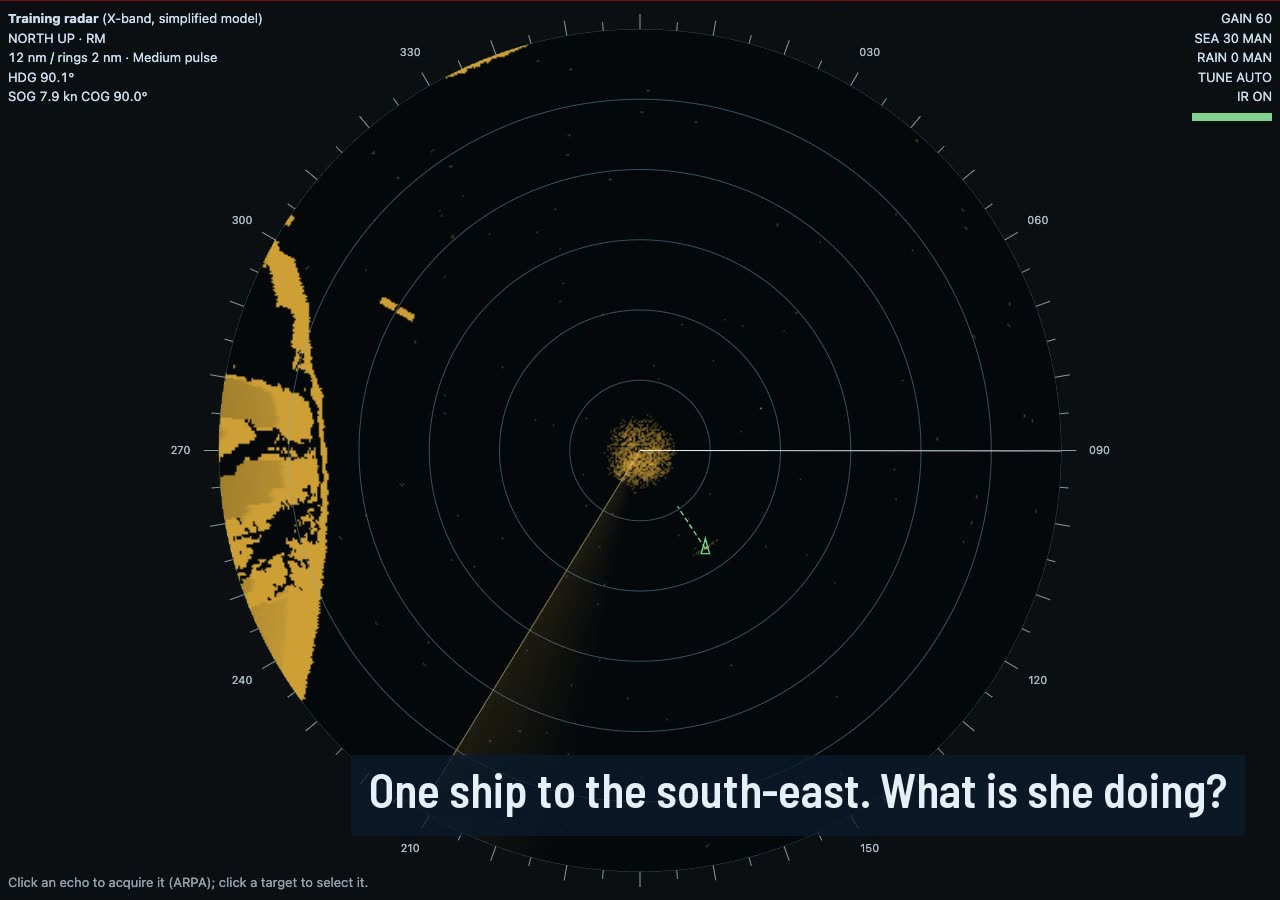
Same water as before: heading east at eight knots, and the coaster closing from the starboard bow, about four miles off.
This time you won't acquire her by hand. You'll set an ARPA acquisition zone, so the radar takes any ship that comes inside it and warns you.
Set the zone
On the radar, switch the acquisition zone on. Put the inside edge at about one mile, clear of the sea clutter round the ship, and the outside edge at about three.
Too close in and it acquires clutter; too far out and you are told late. Three miles gives you time to assess and act.
Let the zone take her
Now wait and watch. When the coaster crosses the outer ring, ARPA acquires her by itself and gives a warning. Don't click her yourself.
Acknowledge the warning
There is the warning: a new target in the acquisition zone. Acknowledge it, then look at her: which target, what bearing, what range.
What the zone will not do
The zone only takes what paints. A small boat in the clutter, or a ship in a shadow sector, may never be acquired. Small craft may be acquired late, or not at all.
So use it as a second pair of eyes at night or in light traffic, never instead of the look-out or a proper watch on the radar.
The rules and guidance behind it
- MGN 379 (M+F) Amendment 1: use of electronic navigational aids
Do it, then explain it.
Read the answers here for free. With a pass you work this lesson on the bridge, then practise its questions and mark your answers.