ARPA: acquire, assess and act
Acquire a crossing ship, read the CPA, alter boldly to starboard and check the action works.
- Phase 4: Collision avoidance
- 8 steps on the bridge
- 5 oral questions
What you do on the bridge
- Watch the bearing
- Acquire her
- Let the track settle
- Read the CPA
- Relative vectors
- True vectors
- Act early and boldly
- Past and clear
The oral questions, and what a good answer covers
The key points are in our own words. In the course, these questions come once you have done the job.
You acquire a target on ARPA. How long before you can trust what it tells you?Often asked
A good answer covers:
- A trend of its motion within about one minute
- Full accuracy of the predicted motion within about three minutes
- Longer after either ship alters, while the tracker settles again
- Keep watching the bearing and range yourself meanwhile
Show me on the bridgeAcquire the coaster on the starboard bow and watch the track settle.
When would you use true vectors, and when relative?Often asked
A good answer covers:
- Relative vectors show the risk: a vector pointing at own ship means a steady bearing and collision course
- True vectors show what the other ship is really doing: her course and speed, and so her aspect and the rule that applies
- Use both: relative to detect risk, true to decide the action
- In sea stabilisation true vectors match her heading; ground stabilisation can mislead in a strong tide
How do you decide whether risk of collision exists?Often asked
A good answer covers:
- Use all available means: radar, ARPA, AIS, visual bearings and the look-out
- A compass bearing that does not change appreciably means risk exists
- Risk can still exist with a changing bearing, for a large ship or at close range
- Do not decide on scanty information, such as one radar observation or AIS alone
- Systematic observation: plotting or ARPA, over time
A ship is crossing from starboard on a steady bearing. What do you do, and how do you check it worked?Often asked
A good answer covers:
- We are the give-way vessel: take early and substantial action to keep well clear
- Usually a bold alteration to starboard, large enough to be obvious on her radar and to her eyes
- Avoid crossing ahead of her
- Check the action is working: the bearing changes, the CPA opens on ARPA, and keep checking until she is past and clear
- Return to course only when she is finally past and clear
Show me on the bridgeThe coaster crossing from starboard: plan your action.
What are the main limitations of ARPA?
A good answer covers:
- It tracks echoes, so a target lost in clutter, rain or a shadow sector is lost to ARPA too
- Target swap when two echoes pass close to each other
- Errors from wrong heading or speed input, and from the wrong stabilisation
- Delay: a target alteration takes time to show
- It does not tell you which rule applies or what the other ship will do
How the lesson runs
The tutor's narration from the lesson, step by step. On the bridge, each control lights up as it is named.
Brief
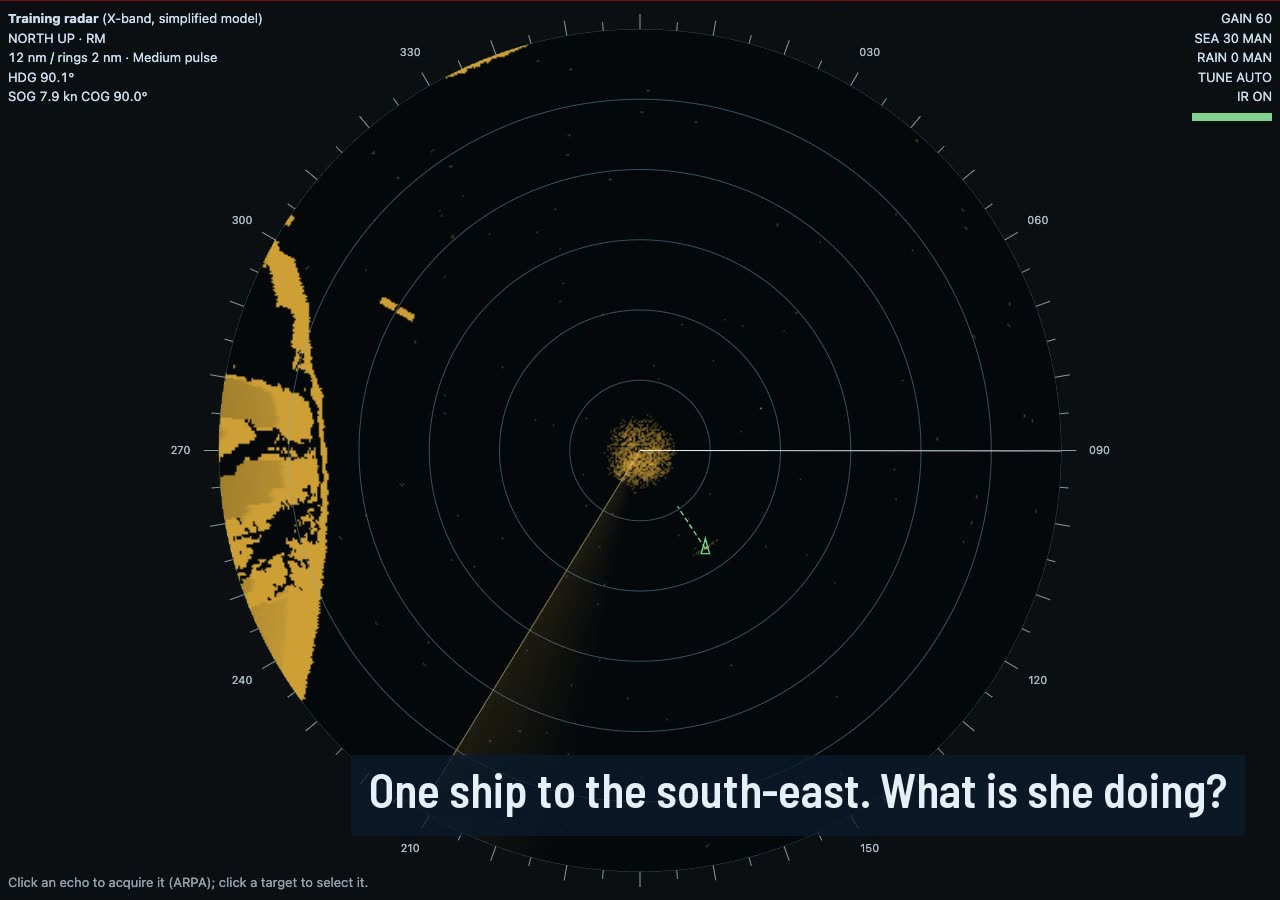
We're heading east at eight knots in open water, radars set up. There's a ship on the starboard bow, about four miles off.
We'll watch her bearing, acquire her on ARPA, read what it tells us, decide whether there's risk of collision, and act. Take the radar.
Watch the bearing
Before any ARPA, put EBL 1 on her. If she stays on the EBL as the range closes, her bearing is steady, and a steady bearing with a closing range means risk of collision.
Acquire her
Now acquire her: click on the echo. The dashed circle means ARPA is still building the track.
Let the track settle
ARPA gives a trend within about a minute, but don't trust the figures fully for about three. Keep watching the EBL in the meantime. Has she moved off it?
Read the CPA
Select her and read the target data: CPA and TCPA. To show you've read it, set VRM 2 to the CPA.
Relative vectors
Switch to relative vectors. Her vector points almost straight at us: that is a collision course, and it agrees with the steady bearing on the EBL.
True vectors
Now true vectors. They show what she's really doing: heading north, across our bow from starboard. She's a crossing ship on our starboard side, so we are the give-way vessel.
Act early and boldly
Give way early and boldly, so it's obvious to her. Alter to starboard, and don't cross ahead of her. On a ship this size, sixty to ninety degrees works well.
Set the new heading on the autopilot, then watch the CPA open. We want at least a mile.
Past and clear
Keep watching until she's past and clear: TCPA negative and the range opening. Only then come back to our course of zero nine zero.
The rules and guidance behind it
- MGN 379 (M+F) Amendment 1: use of electronic navigational aids
Do it, then explain it.
Read the answers here for free. With a pass you work this lesson on the bridge, then practise its questions and mark your answers.