ARPA trial manoeuvre: try it, make it, check it
In fog, plot a crossing ship, find a safe alteration with the ARPA trial, make it, and check it worked.
- Phase 4: Collision avoidance
- 6 steps on the bridge
- 4 oral questions
What you do on the bridge
- Acquire the targets
- Plot the coaster
- Try it first
- Make the alteration
- Check it
- Past and clear
The oral questions, and what a good answer covers
The key points are in our own words. In the course, these questions come once you have done the job.
What does the ARPA trial manoeuvre show you, and what are its limits?Often asked
A good answer covers:
- The predicted CPA and TCPA of every tracked target if we took the trial course and speed
- A delay can be set, to see the effect of acting now or in a few minutes
- It shows TRIAL clearly, so nobody takes the trial picture for the real one
- It assumes the targets hold their course and speed; a set to the current standard models our own turn and speed change and counts down to it, but an older set may not
- It is only as good as the tracks: settled tracks, the right speed input
Show me on the bridgeFog, two targets ahead. Acquire both and try a trial course.
In fog you detect a ship forward of the beam by radar alone. Which alterations does Rule 19 tell you to avoid?Often asked
A good answer covers:
- An alteration to port for a vessel forward of the beam, other than one being overtaken
- An alteration towards a vessel abeam or abaft the beam
- There is no stand-on vessel in restricted visibility: if risk exists, both take avoiding action in ample time
- A ship heard forward of the beam: reduce to the minimum steerageway, and stop if necessary
How big should the alteration be, and why?Often asked
A good answer covers:
- Large enough to be readily apparent to the other ship on her radar
- A succession of small alterations is to be avoided
- Big enough to pass at a safe distance, the CPA the standing orders ask for
- Made in good time, and not leading into another close-quarters situation
You have made the alteration. How do you check it is working?
A good answer covers:
- Trial off first, so the display shows the real picture
- Give the tracks a minute or two to settle after our turn
- Watch the CPA open on ARPA and the bearing change, and keep plotting
- Keep checking until she is finally past and clear before resuming course
Show me on the bridgeAfter the alteration: what would you look at, and for how long?
How the lesson runs
The tutor's narration from the lesson, step by step. On the bridge, each control lights up as it is named.
Brief
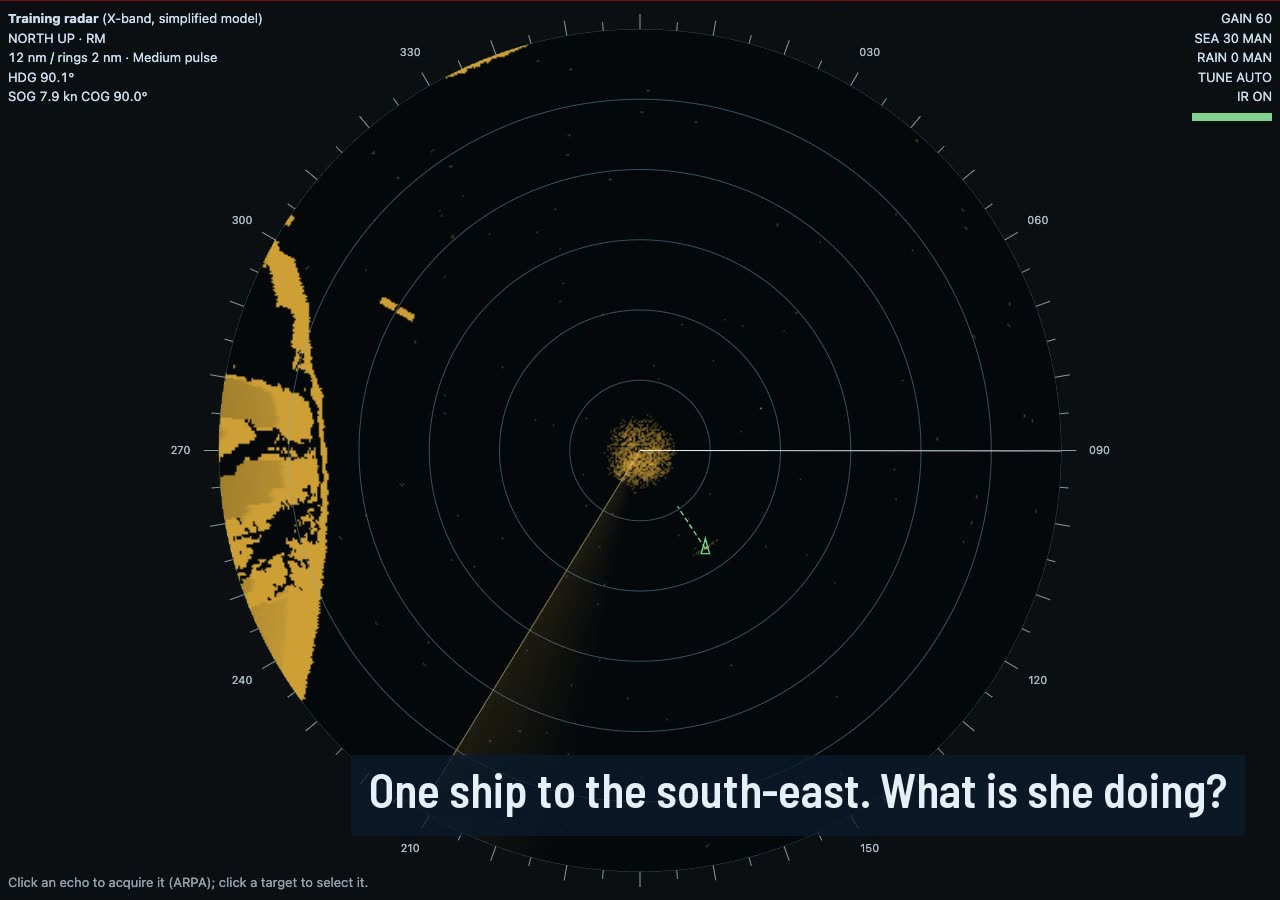
We're in fog, visibility under a mile, eight knots, heading east. There's a coaster on the starboard bow about six and a half miles off with no AIS, and a slow tug ahead that we're catching up.
We'll acquire them, plot the coaster, try an alteration on the ARPA trial until it gives us a mile from both, make it, and check it. Open the radar.
Acquire the targets
Click on the coaster to acquire her, and the tug as well. The trial can only predict tracked targets, so anything you have not acquired will not be in it.
Plot the coaster
While the tracks settle, plot her by hand. Three observations, three minutes apart, off EBL 1 and VRM 1. One reading on its own is scanty information.
Work out her CPA and TCPA from the sheet and hand the plot in. Within three cables and three minutes. Then compare it with what the ARPA says.
Try it first
In fog there's no stand-on ship, and she's forward of our beam, so no turn to port. Enter a trial course to starboard and run the trial. The display shows TRIAL, our trial vector, and where each target would pass.
Keep trying until every tracked target clears by at least a mile. Do it before you put the wheel over. That is the whole point of a trial.
Make the alteration
Now make it, boldly: at least thirty degrees, so she sees it on her radar. Order the trial course and let the ship steady on it, within ten degrees.
Check it
Switch the trial off, so we are looking at the real picture. Give the tracks a minute or two after our turn, then read the CPA of each target. Both should be a mile or more.
Past and clear
Hold the new course and keep watching until she's past and clear: the TCPA negative and the range opening. She should pass at least a mile off.
The rules and guidance behind it
- COLREG Rule 19: conduct of vessels in restricted visibility
- COLREG Rule 8: action to avoid collision
- COLREG Rule 7: risk of collision
Do it, then explain it.
Read the answers here for free. With a pass you work this lesson on the bridge, then practise its questions and mark your answers.