Radar stabilisation: sea or ground, true motion, and a speed log error
See what ground and sea stabilisation do to true vectors in a tide, set true motion, and catch a log reading low.
- Phase 4: Collision avoidance
- 5 steps on the bridge
- 4 oral questions
What you do on the bridge
- Ground stabilised
- Sea stabilised
- True motion and true trails
- Something is wrong
- Report it
The oral questions, and what a good answer covers
The key points are in our own words. In the course, these questions come once you have done the job.
Sea or ground stabilisation: which do you use for collision avoidance, and which for navigation?Often asked
A good answer covers:
- Sea stabilised (log on water track): true vectors show other ships' course and speed through the water, which matches their heading and so their aspect
- That is what the COLREGs judge by, so use sea stabilisation for collision avoidance, especially in a strong tide
- Ground stabilised (GNSS, or the log on bottom track): true vectors show course and speed over the ground, and land and fixed objects stay still
- Use ground stabilisation for navigation, parallel indexing and the radar overlay on the ECDIS
- Relative vectors and the CPA are the same either way: stabilisation changes only the true vectors and trails
Show me on the bridgeAcquire the ship ahead and switch between GNSS and the log for the speed input.
What happens to the radar picture if the speed or heading input is wrong?Often asked
A good answer covers:
- A log reading low makes stationary objects seem to move ahead; reading high, astern. Stopped ships get false true vectors
- A gyro error turns the whole picture, every bearing, and the true vectors with it
- CPA and TCPA from relative motion are not affected by a speed error, but aspect and true course are
- Check the inputs: log against GNSS and the engine, gyro against the magnetic compass and transits
- A fixed echo with a true trail or vector tells you something is wrong
What is the difference between relative and true motion on the radar?
A good answer covers:
- Relative motion: own ship stays fixed on the screen and other echoes move relative to her; their trails show relative motion, and so the risk
- True motion: own ship moves across the screen and is reset when she nears the edge; echoes move as they really do
- In true motion, land stays still when ground stabilised, so it is good for navigation in pilotage waters
- Trails can be relative or true whatever the motion mode; read which before you judge
What is a reference target, and when would you use one?
A good answer covers:
- A fixed echo tracked by the ARPA, such as a rock, a light structure or an anchored ship, used to give ground stabilisation
- Useful when GNSS is lost or doubted and there is no bottom-track log
- The echo must really be fixed: a buoy may move, and an anchored ship swings
- If the reference is lost or swaps, the stabilisation goes wrong with it
How the lesson runs
The tutor's narration from the lesson, step by step. On the bridge, each control lights up as it is named.
Brief
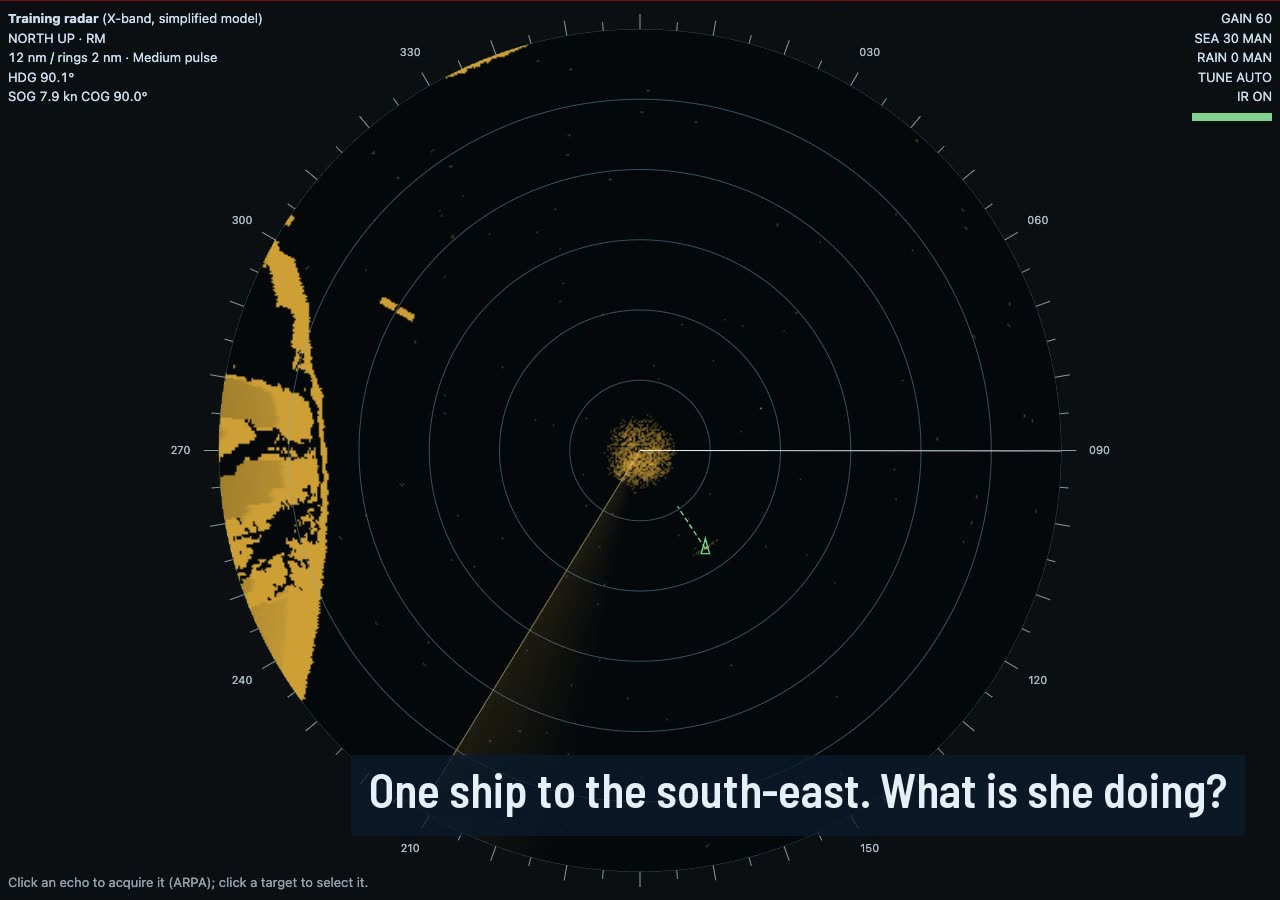
We're heading west at eight knots, with a two knot stream setting south across us. About three and a half miles ahead, a ship is lying stopped and drifting with the stream.
We'll see how the radar's speed input changes what her vector tells us. That is stabilisation, and it matters most when the tide runs hard.
Ground stabilised
The radar is on GNSS for its speed input: ground stabilised. Acquire the ship ahead, set true vectors, and let the track settle.
Her true vector shows about two knots to the south. That is her movement over the ground: the stream carrying her.
Sea stabilised
Now change the speed input to the log, on water track. The radar is sea stabilised: it works in the water, which moves with the stream.
Give the track a minute. Her true vector shrinks to almost nothing: through the water she is stopped. Her heading, not her drift, is what tells you her aspect, so use sea stabilisation for collision avoidance.
True motion and true trails
Set true motion and true trails. Now we move across the screen, and her trail shows what she is really doing. Remember that true trails depend on the stabilisation too: in the sea stabilised picture, the land and the buoys would leave trails.
Something is wrong
Look at her vector now. A ship that was stopped is suddenly doing three knots to the east, and nothing about her has changed. When that happens, suspect our own inputs.
Compare the log with GNSS. GNSS says eight knots over the ground; the log now says under six, with the engine unchanged. The log is reading low. Take the radar off the log: back to GNSS.
Report it
Log the speed log fault, and tell the master. Until it is fixed, anything that takes speed from the log, such as sea stabilisation and dead reckoning, cannot be trusted.
The rules and guidance behind it
- MGN 379 (M+F) Amendment 1: use of electronic navigational aids
Do it, then explain it.
Read the answers here for free. With a pass you work this lesson on the bridge, then practise its questions and mark your answers.