Night watch: night vision, both radars, ECDIS take-over
Set the bridge up for the night, keep both radars running, take over on the back-up ECDIS when the main one fails, and keep clear.
- Phase 5: Passage planning and keeping the watch
- 5 steps on the bridge
- 5 oral questions
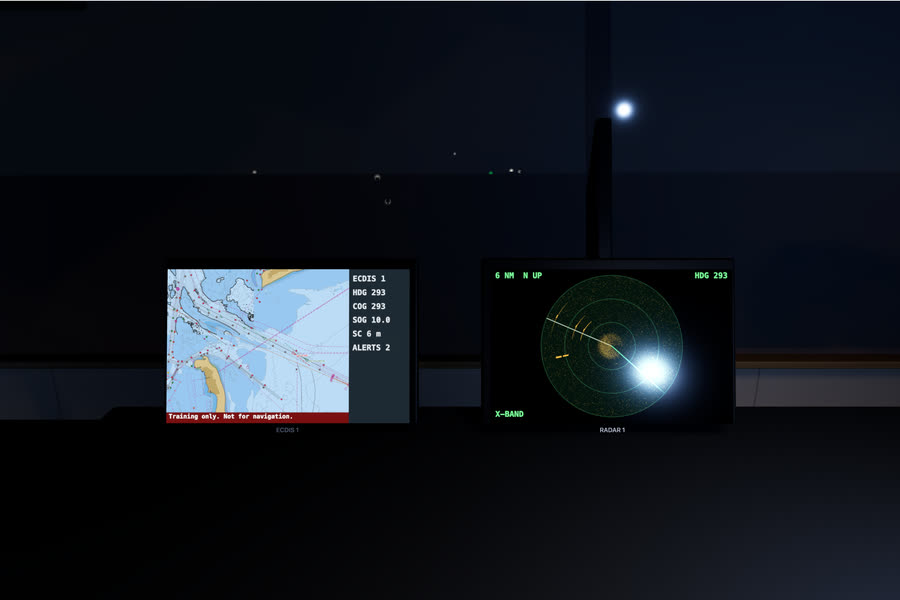
What you do on the bridge
- Navigation lights
- Night vision and the ECDIS palette
- Both radars running
- ECDIS 1 fails
- Keep clear
The oral questions, and what a good answer covers
The key points are in our own words. In the course, these questions come once you have done the job.
How do you keep your night vision on watch, and why does it matter?Often asked
A good answer covers:
- One burst of white light undoes it, so red lighting only in the wheelhouse
- Every screen dimmed to the lowest level you can still read, and the ECDIS on its night palette
- Chart table curtain drawn whenever its lamp is on
- The relieving officer does not take over until their eyes have adjusted
- A lookout who cannot see in the dark is no lookout at all
Show me on the bridgeThe wheelhouse as the day watch left it. Look at the lighting and the screens.
When must the officer of the watch call the master?Often asked
A good answer covers:
- Restricted visibility met or expected
- Traffic, or the movement of another vessel, causing concern
- Difficulty keeping to the course, or land or a mark not sighted when expected, or an unexpected change in depth
- Failure of the engines, steering, or any essential navigational equipment, alarm or indicator
- Radio equipment failure, heavy weather causing concern, or any hazard such as ice or a derelict
- Any other emergency, or whenever in any doubt; the standing and night orders may add more
The main ECDIS fails at night in a busy approach. Talk me through what you do.Often asked
A good answer covers:
- Acknowledge the malfunction alarm and note the time and position
- Take over on the back-up ECDIS straight away and check the route, chart and safety settings on it match
- Check the position on it against radar ranges and visual bearings
- Keep the lookout and the radar plotting going throughout; the traffic does not wait
- Tell the master, log it, and report the defect
- Be ready to go to the paper charts if the back-up fails too
What lights does this yacht show under way at night, and why two masthead lights?
A good answer covers:
- A masthead light forward and a second, higher one abaft it
- The second masthead light is required because she is 50 metres or more in length
- Sidelights, and a sternlight
- No anchor lights: all-round white lights would tell other ships she is at anchor
You come up to take the night watch. What is wrong with this picture?
A good answer covers:
- The anchor lights are still on with the steaming lights
- The wheelhouse lighting is white and bright, so nobody keeps night vision
- The ECDIS is still on its day palette
- Radar 2 is on stand-by, so only one radar is running in traffic
Show me on the bridgeLook at the lights, the lighting, the ECDIS and both radars.
How the lesson runs
The tutor's narration from the lesson, step by step. On the bridge, each control lights up as it is named.
Brief
We're inbound to the Ambrose approach after dark at ten knots, with harbour traffic about. The day watch has left the bridge set up for daylight, and a few things wrong.
You have five minutes to put the lights right, get the wheelhouse dark, put the ECDIS on night colours and get the second radar running. Then keep a good watch, because something will fail.
Navigation lights
First, what are we showing? The anchor lights are still on with the steaming lights. Under way she shows two masthead lights, sidelights and a sternlight, and nothing else, so switch both anchor lights off.
Night vision and the ECDIS palette
Now protect your eyes. Your night vision takes a long time to come and a moment to lose. At the wheelhouse lighting panel, put the deckhead lights to red, bring the console dimmer down to forty percent or less, and draw the chart table curtain.
The ECDIS is still on day colours, which will dazzle you every time you look at it. Put it on the night palette.
Both radars running
Radar 2 was left on stand-by. At night in traffic we run both. The X-band gives the finer picture close in, and the S-band sees further and copes better with rain and sea clutter. Put radar 2 to transmit.
ECDIS 1 fails
About ten minutes in, ECDIS 1 fails. Don't stand and stare at a black screen. Acknowledge the malfunction alarm and take the watch over on ECDIS 2 within two minutes.
On ECDIS 2, check the route and the safety settings are the same, and check its position against the radar. Then tell the master.
Keep clear
All the while, the traffic keeps coming. Keep a lookout by eye and on both radars, acquire anything that may close, and act early. No vessel is to come within half a mile of us through the twenty minute watch.
Do it, then explain it.
Read the answers here for free. With a pass you work this lesson on the bridge, then practise its questions and mark your answers.