IALA Region B: into the Ambrose Channel at dusk
Identify the safe water buoy, take her through the entrance gate and up the Ambrose Channel with every red buoy to starboard.
- Phase 2: Publications and the chart table
- 3 steps on the bridge
- 4 oral questions
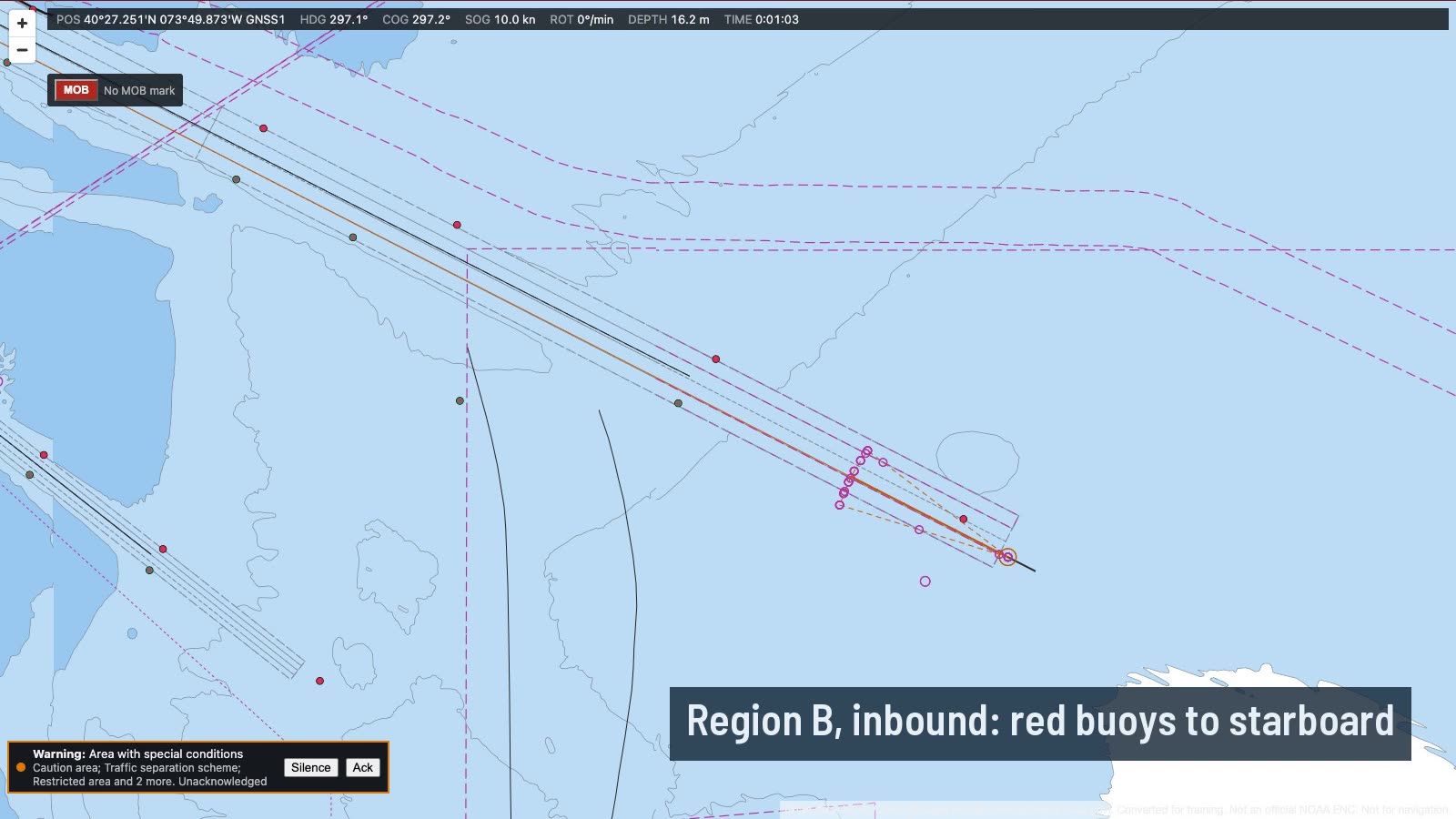
What you do on the bridge
- The safe water buoy
- The entrance gate
- Up the channel
The oral questions, and what a good answer covers
The key points are in our own words. In the course, these questions come once you have done the job.
What is the difference between IALA Region A and Region B?Often asked
A good answer covers:
- Only the colours of the lateral marks differ; cardinal, isolated danger, safe water and special marks are the same
- Region B: red marks to starboard and green to port when going in the direction of buoyage, red right returning
- Region A: the reverse, red to port and green to starboard
- Region B covers the Americas, Japan, Korea and the Philippines; Region A most of the rest of the world
- Shapes are the same in both: can to port, cone to starboard, and numbers usually even on the starboard hand marks
Show me on the bridgeAhead, the safe water buoy, then the entrance gate: green buoy 1 to port, red buoy 2 to starboard.
What is the direction of buoyage, and how do you know it?Often asked
A good answer covers:
- Going in from seaward towards a harbour, river or estuary
- Elsewhere it is set by the authority and shown on the chart by a symbol where it might be in doubt
- Check the chart before relying on red and green
Describe a safe water mark, and what does it tell you?
A good answer covers:
- Red and white vertical stripes, a single red sphere topmark, a white light: isophase, occulting, one long flash every 10 seconds, or Morse A
- Safe water all round it: often the landfall or the centre line of a channel
- Ambrose buoy A shows Morse A
What is a preferred channel mark?
A good answer covers:
- Where a channel divides, it shows the preferred channel by its main colour and a broad band of the other
- It is treated like the lateral mark of its main colour; the preferred channel is on the other side
- Its light is composite group flashing (2+1) in the colour of the main band
How the lesson runs
The tutor's narration from the lesson, step by step. On the bridge, each control lights up as it is named.
Brief
We're inbound to New York at dusk, coming up to the Ambrose safe water buoy. These are IALA Region B waters: going in from sea, red buoys are left to starboard and green to port.
You have the con on the autopilot. Take her past the safe water buoy, through the entrance gate between buoys one and two, and up the channel past buoys three to six.
The safe water buoy
Ahead is the safe water buoy: red and white stripes by day, and at night a white light flashing Morse A, short long. Take a bearing of it to identify it. It can be passed on either side, but give it room.
The entrance gate
Now the gate: green buoy one and red buoy two. Steer to pass between them, red to starboard. Small alterations on the autopilot, and watch how the buoys move against the background.
Up the channel
Keep her in the channel: red four and six to starboard, green three and five to port. At night the colours of the lights tell you which is which before you can see the buoys.
The rules and guidance behind it
- NOAA chart and US Coast Guard Light List: Ambrose Channel buoys
Do it, then explain it.
Read the answers here for free. With a pass you work this lesson on the bridge, then practise its questions and mark your answers.